
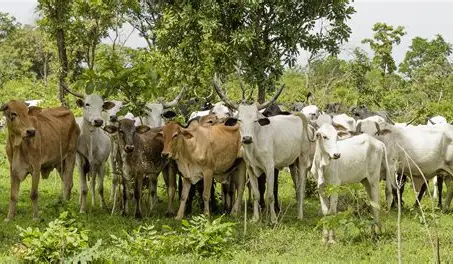


The Lagos State Butchers Association has raised fresh concern over what it describes as a steep and sustained increase in the cost of cattle, with prices reportedly climbing to as high as N2.5 million per cow, a development traders say is reshaping Nigeria’s meat market and pushing retail prices upward.
Speaking receny the association’s patron, Alhaji Bamidele Kazeem, said the sharp rise is no longer an isolated market fluctuation but a reflection of wider structural pressures affecting livestock supply across the country.
According to him, cows that sold for about N1.7 million in 2025 now sell between N2.3 million and N2.5 million, with even lower-grade cattle becoming increasingly scarce in major urban markets like Lagos.
But beyond the headline price increase, stakeholders say the situation reveals a deeper problem: a fragile and overly centralised livestock distribution system that depends heavily on long-distance transport from northern Nigeria.
Butchers say the rising cost is being driven by a combination of insecurity along livestock routes, escalating fuel prices, and transportation bottlenecks, all of which have significantly increased the cost of moving cattle from production zones to consumption centres.
In practical terms, traders are now paying more not just for cattle, but for the logistics of getting them to market—costs that are ultimately passed on to consumers.
“The car I bought in 2020 for N2.1 million is now cheaper than the price of a cow,” Kazeem noted, underscoring the severity of the inflationary pressure in the livestock chain.
Structural Gaps in Local Production
Industry stakeholders also point to Nigeria’s slow transition from open grazing and long-distance cattle movement to modern ranching and feedlot systems as a key factor worsening supply shortages.
In Lagos, the proposed Eko Ranching Project in Epe—which was expected to boost local cattle production and reduce dependence on northern supplies—has yet to fully take off. Butchers argue that this delay has left the state exposed to external shocks in supply and pricing.
The continued reliance on northern supply corridors means any disruption—whether insecurity, fuel price hikes, or transport restrictions—quickly translates into higher prices in southern markets.
Beyond Butchers: A National Food Inflation Signal
Economists and market observers say the situation reflects a broader pattern in Nigeria’s food economy, where rising logistics costs and insecurity are combining to drive up prices across multiple commodities.
Beef, being one of the most widely consumed protein sources, is particularly sensitive to these shocks. As cattle prices rise, meat prices in urban centres are expected to follow, adding further pressure to household food budgets already strained by inflation.
Policy Gap and the Ranching Question
The Lagos butchers are urging authorities to accelerate investment in structured livestock farming, particularly ranching and feedlot systems, which they believe could stabilise supply, reduce transportation costs, and create new agricultural jobs.
They argue that without a deliberate shift away from the current system, Nigeria will continue to face recurring cycles of scarcity-driven price spikes.
“The gains of ranching are enormous. It will reduce dependence on long-distance supply and help stabilise meat prices,” Kazeem said.
A Broader Economic Warning
While the current alarm is coming from butchers in Lagos, the implications extend far beyond the state. Analysts say the rising cost of cattle is a clear indicator of mounting pressure within Nigeria’s broader food distribution system.
It highlights how insecurity, energy costs, and infrastructure gaps are now directly feeding into food inflation—turning a livestock market issue into a national economic concern.
For consumers, the impact is already visible at the point of purchase. For producers and traders, it signals a market under increasing stress. For policymakers, it presents yet another reminder that stabilising food prices will require structural reforms rather than short-term interventions.