
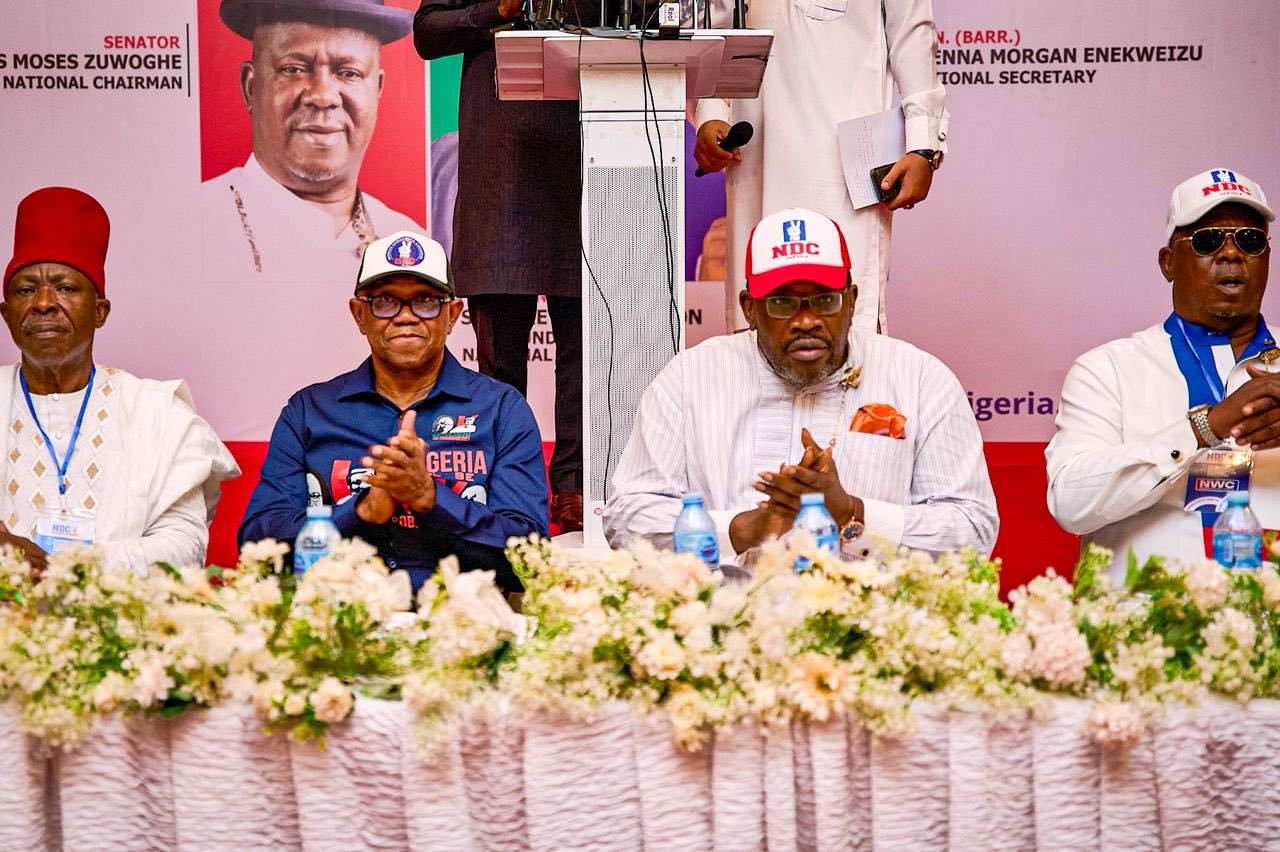

The second National Executive Committee (NEC) meeting of the Nigeria Democratic Congress (NDC) in Abuja on Wednesday took on the tone of a high-stakes political turning point, as National Leader, Senator Seriake Dickson, delivered a forceful and emotionally charged address that blended praise, warning, and strategic direction for the party’s future ahead of the 2027 general elections.
Dickson, addressing top party officials, legislators, governors-in-waiting, and the party’s presidential candidate, Peter Gregory Obi, declared that the NDC had moved beyond its fragile beginnings and was now firmly on course to becoming a dominant national political force.
He described the party’s journey as one marked by doubt, resistance, and political hostility, but insisted that its survival and rapid expansion proved that it had already overcome its earliest existential tests.
“We were written off before we even started,” he said. “But today, we are not just surviving—we are building a movement that is becoming national in character and unstoppable in spirit.”
The former Bayelsa State governor praised party members for what he called “extraordinary resilience,” noting that despite being newly formed, the NDC had succeeded in establishing structures across all states of the federation and the Federal Capital Territory.
According to him, the party has fielded candidates in governorship races, National Assembly contests, and state assembly elections nationwide, a development he said reflects both organisational discipline and growing public acceptance.
Dickson said the strength of the party was evident in the turnout and enthusiasm witnessed during its primaries, describing it as a clear sign that Nigerians were eager for a political alternative.
“What we are witnessing is not ordinary politics,” he said. “It is the emergence of a national movement. The energy, the participation, and the belief in our message are overwhelming.”
He urged party members to remain focused and not be distracted by internal disagreements or external criticism, insisting that the NDC’s mission was larger than individual ambitions.
A key highlight of his address was a strong appeal for unity following the party’s recent primaries. Dickson acknowledged that electoral contests often produce grievances, but insisted that the party must prioritise reconciliation and collective progress.
“To those who contested and did not succeed, I say this clearly: you are still part of this movement,” he said. “Today’s outcome does not define your political future. The party remains your platform, and tomorrow may present another opportunity.”
He announced that a formal reconciliation framework would soon be activated to address internal disputes and ensure that aggrieved aspirants are reintegrated into party structures.
According to him, unity is not optional but essential if the party hopes to translate its growing popularity into electoral victory in 2027.
In one of the most significant policy announcements of the meeting, Dickson revealed that the NDC would be undergoing major internal reforms in its electoral processes, including a transition from manual voting systems to full electronic voting for all party congresses and primaries.
He described the reform as a bold step toward transparency, accountability, and credibility, arguing that modern political organisations must embrace technology or risk falling behind.
“We cannot build a modern political party with outdated systems,” he said. “From the next cycle, our voting process will be fully electronic. This is about trust, transparency, and efficiency.”
Dickson stressed that Nigeria itself must embrace electoral modernization, adding that the NDC intended to lead by example in demonstrating how internal party democracy could be strengthened through technology.
He also used the occasion to formally welcome new entrants into the party, describing them as “co-builders of a national vision” rather than mere defectors from other political platforms.
According to him, the NDC remains open to all Nigerians committed to reform, good governance, and national renewal, regardless of previous political affiliations.
“We are not building a closed party. We are building a national platform,” he said. “Anyone who believes in our vision is welcome to join and contribute.”
Dickson further commended the party’s presidential candidate, Peter Obi, and his running mate, Dr. Rabiu Musa, describing their candidacy as a major boost to the party’s national credibility and appeal.
He said their entry into the party had strengthened its reach across regions and social groups, adding momentum to what he described as an already growing political movement.
Their emergence, he said, reflected the party’s ability to attract respected national figures who share its vision for reform and transformation.
The NEC meeting also featured strong reaffirmations from party leaders who pledged loyalty to the NDC’s leadership and commitment to its long-term goals.
Dickson, however, cautioned against complacency, warning that internal discipline must be maintained if the party is to sustain its momentum.
He also criticised the state of governance in the country, arguing that Nigeria had suffered years of mismanagement and declining public trust in leadership, though he avoided direct confrontation with rival parties in his formal remarks.
As the meeting progressed, delegates repeatedly interrupted his speech with chants of solidarity, reflecting the heightened political atmosphere inside the hall.
The session ended on a highly energetic note, with party leaders adopting renewed commitments to reconciliation, expansion, and electoral preparedness ahead of the 2027 general elections.
For Dickson, the message was unambiguous: the NDC is no longer a new experiment in Nigerian politics, but a rapidly consolidating force preparing for a serious national contest.
“The journey is still ahead of us,” he concluded. “But make no mistake—we are building something that will shape the future of Nigeria.”