
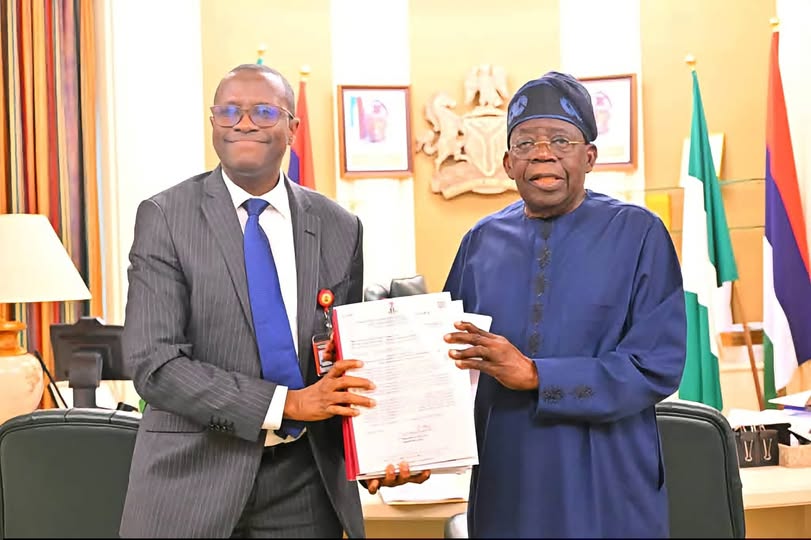

The Independent Corrupt Practices and Other Related Offences Commission (ICPC) has uncovered what could be a wider institutional fraud beyond the controversial Presidential Foreign Investment Promotion Council (PFIPC), revealing that its purported Director-General, Adeniyi Adeyemi Mathew, allegedly created additional fictitious government agencies and forged legislative instruments to make them appear legitimate.
ICPC Chairman, Dr. Musa Adamu Aliyu, SAN, disclosed the findings on Thursday in Abuja while presenting the commission’s interim report on the 30-day investigation ordered by President Bola Tinubu into the activities of the purported PFIPC.
The investigation, according to Aliyu, has established that the controversial appointment was built on a false foundation: Adeyemi was never appointed by the Federal Government, while the PFIPC itself was never legally created.

But the commission’s latest revelations suggest the alleged scheme went considerably further.
Aliyu said investigators discovered that Adeyemi allegedly established two other fictitious bodies—the FCT Investment Promotion Agency (FIFA) and the Foreign Investment Promotion Agency and Public Private Partnership (FIFA-PPP).
To reinforce the appearance of legitimacy, the ICPC said Adeyemi allegedly forged legislative instruments presented as enabling Acts for the fictitious agencies and used them to facilitate the opening of bank accounts.
The development raises a broader question about how purported government institutions could allegedly be created on paper, backed by forged legal documents and presented to institutions as legitimate entities.
The ICPC chairman said the appointment letter presented by Adeyemi was also forged.
“The fake appointment letter of Adeniyi Adeyemi Mathew did not originate from the Presidency,” Aliyu declared.
He said the commission found that the PFIPC had no foundation in any Act of the National Assembly, executive order or other valid government instrument.
The purported agency, he added, allegedly appropriated the offices and operational instruments of the former Presidential Economic Advisory Council (PEAC), further creating an appearance of official authority.
According to the commission, Adeyemi allegedly engaged in false representation, widespread impersonation and other illegal activities while operating the purported agency.
Yet, despite the scale of the alleged operation, the ICPC said its investigation found no evidence that Federal Government funds were approved or released to the purported PFIPC or PEAC.
It also found no systemic weakness in the processes of the State House or the Central Bank of Nigeria, with Aliyu declaring that the systems examined in the two institutions were “above board.”
The more troubling issue, however, may lie in what happened around the government’s formal systems.
Aliyu said the investigation identified weaknesses in verification and inter-agency oversight that were allegedly exploited by Adeyemi, with some level of negligence and connivance by public officers.
That finding has prompted the ICPC to recommend administrative sanctions against officials whose alleged omissions or negligence facilitated the operation.
The commission also recommended the full prosecution of Adeyemi and institutional reforms to close the loopholes that allegedly allowed the purported agency to operate.
But the investigation is not over.
Aliyu disclosed that the ICPC is still examining the activities and bank accounts allegedly linked to PFIPC, Adeyemi and his collaborators.
The unfolding investigation therefore goes beyond the question of whether Adeyemi was a genuine presidential appointee.
It now centres on how a purported government agency that allegedly did not exist in law was able to project itself as legitimate, acquire official-looking documents, appropriate government facilities, establish other supposed agencies and allegedly open bank accounts.
The answers, the ICPC indicated, could reveal whether the PFIPC controversy was the work of an isolated impersonator or evidence of a wider network that exploited weaknesses within Nigeria’s government verification and oversight systems.