
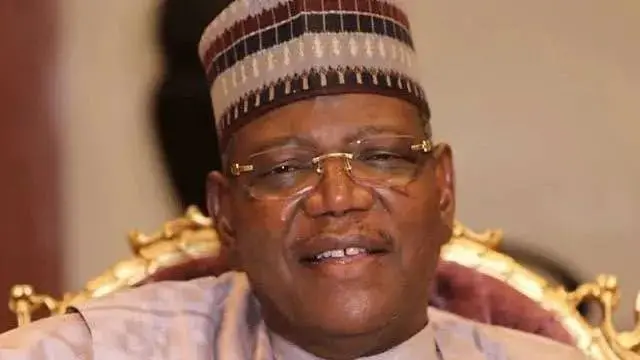

For Sule Lamido, victory at Nigeria’s highest court has brought little comfort—only a sobering reminder of how far the Peoples Democratic Party (PDP) has drifted from its foundations.
Although the Supreme Court ruled in his favour over the contentious 2025 national convention, the former Jigawa governor describes the outcome not as a triumph, but as a costly revelation of a party in disarray. In his view, the legal win merely confirms what many insiders already fear: the PDP is fractured, weakened, and struggling to hold itself together.
Lamido had challenged the party after being excluded from contesting the national chairmanship—denied nomination forms despite a court order halting the process. The disputed Ibadan convention went ahead regardless, producing Kabiru Tanimu Turaki as chairman before the Supreme Court eventually nullified the exercise.
Yet, instead of vindication, Lamido sees irony. Many of the political heavyweights who backed that convention—and opposed him—have since abandoned the PDP altogether, crossing over to the ruling All Progressives Congress (APC). What remains, he suggests, is a hollowed-out opposition, battered by internal conflict and elite defections.
He accuses party leaders of turning what should be a political family into a battleground driven by ego, ambition, and short-term calculations.
To Lamido, the crisis runs deeper than a leadership tussle. It is, in his words, a “family fight” that has taken on a dangerous, personal dimension.
He argues that internal competition is natural in a democratic party, but warns that the PDP’s struggles have crossed into destructive territory—where personal pride overshadows collective purpose. The result, he says, is a collapse of trust and shared vision.
Even his own courtroom success cannot mask that reality.
“We won, yes—but at what cost?” he asks, questioning how the party can rebuild unity after such bitter divisions.
Lamido also broadened his critique to Nigeria’s wider political climate, lamenting what he sees as a growing obsession with power struggles at the expense of governance.
He warned that the country’s leadership—across both ruling and opposition camps—is increasingly focused on temporary fixes rather than long-term solutions. Issues like insecurity, poverty, and social fragmentation, he argued, are being sidelined while politicians trade positions and pursue legal battles.
To illustrate his point, he likened current governance to treating a critically ill patient with painkillers instead of addressing the underlying disease.
Lamido revealed that, had he emerged as PDP chairman, his plan was to reunite the party’s old guard—figures such as Olusegun Obasanjo, Atiku Abubakar, and Goodluck Jonathan—to signal a return to stability and strength.
He believes many politicians currently aligned with rival parties are willing to return, but only if the PDP can present itself as a credible, united platform.
That vision, however, now appears more distant.
Despite everything, Lamido insists the PDP still holds a unique place in Nigeria’s political history and future. He describes it as more than just a party—a “home” built on shared struggle and legacy.
But he is clear-eyed about the challenge: legal victories alone cannot heal political wounds.
Reconciliation, he says, is the only path forward.
“No matter what the courts decide, politics requires dialogue,” he noted, urging party members to set aside grievances and rebuild trust.
For now, Lamido’s “victory” stands as both a personal vindication and a stark warning—a sign that without urgent introspection and unity, the PDP risks losing not just elections, but its identity.