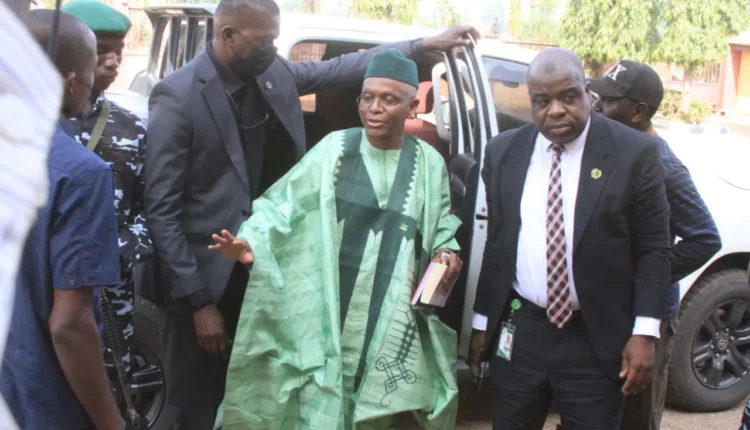

The prosecution of former Kaduna State Governor, Nasir El-Rufai, has exploded into a full-blown political and legal showdown, with the Human Rights Writers Association of Nigeria (HURIWA) accusing President Bola Ahmed Tinubu of turning Nigeria’s enforcement architecture into a political battlefield.
In a hard-hitting intervention, HURIWA alleged that the combined weight of the Economic and Financial Crimes Commission (EFCC), Independent Corrupt Practices and Other Related Offences Commission (ICPC), and Department of State Services (DSS) is being deployed in a coordinated squeeze to keep El-Rufai entangled in a widening legal net.
At the heart of the controversy is the steady expansion of charges against the former governor — evolving from a narrow three-count case into a broader five-count amended charge with national security implications.
But for HURIWA, the issue is not the charges themselves — it is the pattern.
“What we are witnessing is a legal chokehold — a system where charges evolve not to conclude justice, but to prolong control,” the group said.
The rights body warned that such tactics blur the line between lawful prosecution and political containment.
The temperature rose further following the refusal of the Kaduna State High Court, presided over by Justice Darius Khobo, to grant bail to El-Rufai.
HURIWA described the ruling as a turning point, arguing that it signals a shift from legal caution to what it termed “preventive detention by procedure.”
“A man is presumed innocent, yet held as though conviction has already been secured,” the group stated.
According to HURIWA, the reliance on potential interference — without concrete proof — sets a troubling precedent for future cases.
Beyond the courtroom, the group’s most pointed criticism was directed at the perceived state of judicial independence.
HURIWA warned that the optics of the case — multiple agencies, expanding charges, and prolonged custody — risk reinforcing public suspicion that the judiciary is no longer insulated from executive influence.
“When justice appears choreographed, trust collapses,” the statement said.
In a notable shift, HURIWA framed the issue as bigger than El-Rufai himself, positioning the case as a stress test for Nigeria’s democratic institutions.
“This is no longer about one politician. It is about whether the system can guarantee fairness even in politically sensitive cases,” it argued.
The group cautioned that selective application of the law could deepen political fault lines and weaken already fragile public confidence.
HURIWA demanded an immediate reset of the legal process, including the harmonisation of charges across agencies and the grant of bail under strict, enforceable conditions.
It insisted that justice must be seen to be even-handed, transparent, and free from the perception of political interference.
As trial dates approach, the El-Rufai case is fast evolving into a defining moment — not just for the individuals involved, but for the credibility of Nigeria’s justice system.
For now, the question lingers in Abuja’s political corridors: is this the firm application of the law — or the sharpening edge of power?