
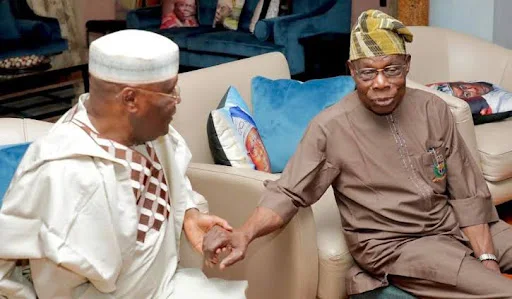


Former Vice President Atiku Abubakar on Friday pushed back against allegations by former President Olusegun Obasanjo that he sponsored an impeachment plot against him in 2002, describing the accusation as a calculated political attack designed to influence the build-up to the 2027 presidential election.
Breaking his silence less than 24 hours after Obasanjo’s claims became public, Atiku said the former President’s account was not only unfair but also sought to revive a decades-old political dispute for contemporary electoral advantage.
In a statement issued by his Senior Special Assistant on Public Communication, Phrank Shaibu, the former Vice President said Obasanjo’s allegations amounted to an attempt to rewrite history while denying one of the principal actors, the late former Speaker of the House of Representatives, Ghali Umar Na’Abba, the opportunity to respond.

“It is unfair to make such grave allegations against a man who is no longer alive to defend himself,” the statement said.
Atiku questioned why Obasanjo never publicly levelled the accusation while Na’Abba was alive or pursued legal action if there was evidence to substantiate the claim.
He argued that no court or official investigation had ever established that he financed or orchestrated any impeachment plot against the former President.
The former Vice President also linked the renewed accusations to the political atmosphere ahead of the 2027 general election, suggesting that the timing was intended to weaken his presidential bid.

“The timing of these claims raises legitimate questions about their political purpose,” he said, adding that Nigerians deserved issue-based politics rather than the resurrection of unresolved political quarrels from more than two decades ago.
Responding to Obasanjo’s suggestion that their relationship broke down because of his alleged presidential ambition, Atiku insisted that the defining point of disagreement between them was his opposition to the controversial third-term agenda during the Obasanjo administration.
He maintained that his decision to resist constitutional amendments that would have extended Obasanjo’s tenure was guided by his commitment to democracy and the rule of law.
According to him, revisiting old political battles does little to address the urgent concerns confronting Nigerians, including rising living costs, insecurity, unemployment and economic uncertainty.
Atiku, who is the African Democratic Congress (ADC) presidential candidate for the 2027 election, said his focus remains on presenting policy alternatives and offering solutions to the country’s challenges rather than engaging in personal political feuds.
While acknowledging Obasanjo’s right to endorse any candidate of his choice, he argued that such support should be expressed openly instead of being advanced through allegations that cannot now be independently tested because of the death of a central figure in the controversy.
The exchange follows Obasanjo’s claim that Atiku provided ₦5 million to then House Speaker Na’Abba to commence impeachment proceedings against him in 2002 and harboured ambitions to remove him from office after only one term.
The fresh war of words underscores the enduring rivalry between the two former allies, whose political partnership collapsed during their second term in office and has since evolved into one of the defining rivalries in Nigeria’s democratic history.