
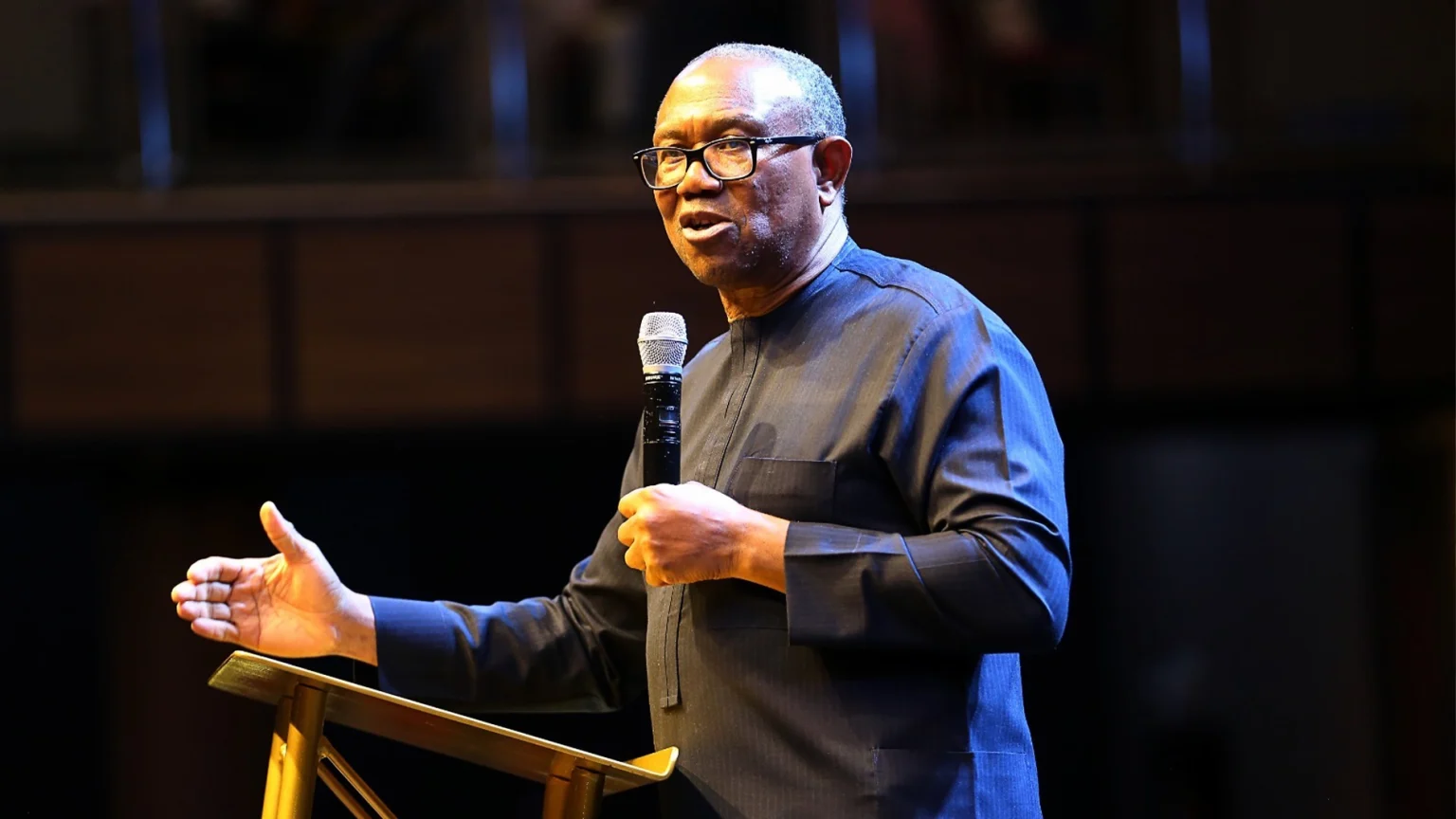

Presidential candidate of the Nigeria Democratic Congress (NDC), Peter Obi, has warned that Nigeria’s democratic crisis is deepening because institutions and professional groups expected to protect constitutional government are increasingly becoming part of the problem.
Obi argued that the country’s democratic challenge has moved beyond the conduct of politicians and political parties, warning that the erosion of institutional checks and accountability could eventually make electoral manipulation, impunity and abuse of power appear normal.
The former Anambra State governor spoke on Tuesday at the 2026 Goodluck Jonathan Foundation Democracy Dialogue in Bauchi, where former political leaders, constitutional experts, civil society actors and other stakeholders examined the future of democracy in Nigeria and Africa.
The dialogue, themed “Beyond Elections: Can Political Parties and the Judiciary Save African Democracy?”, provided the backdrop for Obi’s sweeping criticism of the institutions at the centre of Nigeria’s democratic process.
He warned that when institutions established to restrain political power begin to accommodate or legitimise its excesses, democracy becomes vulnerable regardless of how frequently elections are conducted.
Obi drew from his personal experience in the courts when challenging his election as governor of Anambra State, recalling that he spent three years pursuing the case and obtained favourable judgments from judges he said he had never met.
“I was in court for three years challenging my election. Five judges that I never met for one day gave judgment in my favour. It cannot happen in Nigeria of today,” Obi said.
He said a similar experience occurred at the Court of Appeal, where another five-member panel, according to him, ruled in his favour despite having no prior relationship with him.
Obi used the experience to contrast what he described as the independence of the judiciary at the time with the current state of democratic institutions.
He alleged that the boundaries between political power and institutions designed to check it were becoming increasingly blurred.
“So, if you look at that and look at what is happening today in Nigeria where professors are now aiding illiterates to rig elections, where our lawmakers have removed forgery as an offence in electoral matters, and Senior Advocates of Nigeria are defending forgery,” he said.
The NDC candidate also extended his criticism beyond politicians and public institutions to religious leaders, accusing some of providing moral or spiritual cover for politicians accused of wrongdoing.
“Our religious leaders are now praying for criminal politicians for blessings. We have a crisis,” he declared.
Obi reserved some of his strongest words for the judiciary, suggesting that an institution that should serve as the final arbiter of electoral disputes was itself under increasing political pressure.
“And above all, our judges are now singing on your mandate,” he said.
His remarks amounted to a wider warning that the credibility of democracy depends not only on voters casting ballots but also on whether the institutions responsible for validating, regulating and adjudicating the electoral process remain independent.
According to Obi, elections become meaningless if electoral rules can be manipulated, legislative safeguards weakened and judicial decisions perceived as vulnerable to political influence.
He urged Nigerians to therefore look beyond individual politicians and political parties and examine the institutional structures that allow democratic abuses to persist.
Obi warned that the consequences of institutional decay would extend beyond the current political generation.
He said practices being tolerated today could become entrenched and eventually leave younger Nigerians with a weaker democratic system and fewer institutional protections.
“We need to reverse this because the abuse we are allowing today will take its revenge on our children,” he said.
The former governor argued that rebuilding democracy would require more than electoral reforms, stressing the need for institutions capable of resisting political pressure and enforcing constitutional standards without fear or favour.
His intervention comes as political parties intensify preparations for the 2027 general elections, with the credibility of elections, judicial independence, institutional accountability and the conduct of political actors expected to remain central issues in the emerging campaign.
The Democracy Dialogue therefore provided Obi with an opportunity to frame the 2027 contest not merely as a competition between political parties, but as a test of whether Nigeria can rebuild institutions capable of protecting citizens’ votes and enforcing democratic accountability.
The event was chaired by former President Olusegun Obasanjo and attended by former President Goodluck Jonathan and former Vice President Namadi Sambo.
Bauchi State Governor Bala Mohammed hosted the gathering, which attracted political leaders, constitutional experts, civil society representatives and other stakeholders from Nigeria and beyond.
Obi’s central warning was that democracy cannot survive on elections alone: when the institutions meant to protect the ballot, enforce the law and restrain political power begin to fail, the entire democratic system becomes vulnerable.