


By Salihu Othman Isah
There are moments in a nation’s life when history does not ask for a crowd. It asks for one man.
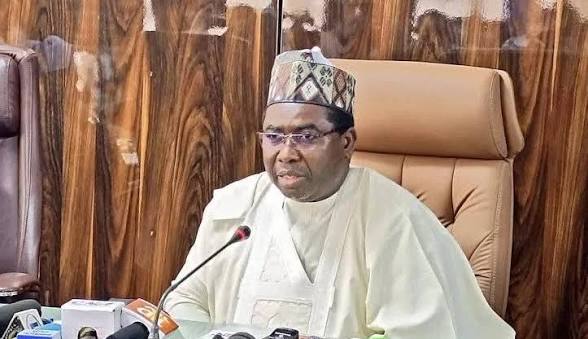
For Nigeria, as it marches toward the 2027 general elections, that man is Professor Joash Ojo Amupitan.

He did not seek the spotlight. He did not campaign for the job. He did not come with the swagger of a politician or the noise of a partisan gladiator. He came, quietly, from the lecture hall and the law court, carrying with him something Nigeria’s electoral system has been starved of for years: credibility.
And now, whether he likes it or not, the fate of Nigeria’s democracy rests heavily on his shoulders.
Amupitan was appointed Chairman of the Independent National Electoral Commission at a time when trust in INEC was at its lowest ebb. The 2023 elections had left scars that had not healed. The IReV glitches, the delayed uploads, the disputed results, the court battles — all of it had combined to create a dangerous feeling among Nigerians: that their votes did not matter, that the system was rigged, that the umpire was compromised.
To appoint a new chairman after that was not just to fill a vacancy. It was to attempt a resurrection.
President Bola Tinubu’s choice of Amupitan was, for many, a surprise. He was not a household political name. He was not a former governor, not a minister, not a party chieftain. He was a Professor of Law, a Senior Advocate of Nigeria, a man whose reputation was built in classrooms, courtrooms and law books, not in campaign rallies.
But that was precisely the point.
Nigeria did not need another politician to run its elections. It needed a jurist. It needed a man who understands that law is not suggestion, that process is not decoration, that credibility is not granted by office but earned by conduct.
In the few months since he took office, Amupitan has shown Nigerians what that difference looks like.
First, he told the truth, even when the truth was embarrassing.
On 9th November 2026, Amupitan did what no INEC chairman before him had dared to do so openly. He stood before Nigerians and admitted that the Continuous Voter Registration exercise had been infiltrated. He announced that INEC had removed 1,608,660 invalid registrations. He added 873 records of deceased persons. Total deleted: 1,609,553.
He did not hide it. He did not blame hackers. He did not blame the opposition. He owned it.
And then he went further. He revealed that 54 individuals across 10 states had been identified as allegedly involved in the irregularities and would face disciplinary action and possible prosecution.
In a country where institutions bury their sins, Amupitan exhumed his and displayed them in public. That is not weakness. That is strength. That is leadership.
Second, he has refused to be owned.
One of the most damaging criticisms of his predecessor, Professor Mahmood Yakubu, was that after leaving INEC, he accepted a diplomatic appointment from the government he had just conducted elections for. Whether fair or not, that decision fed the narrative that INEC chairmen serve the president and are rewarded afterwards.
Amupitan has drawn a line.
At Chatham House in London, on 12th November 2026, he pledged before an international audience that he would not accept any political or diplomatic appointment after his tenure. He would serve, and he would go home.
That single pledge, made without prompting, did more to restore confidence in INEC than a thousand press releases. It told Nigerians: I am not here for a job after this job. I am not here to please anyone. I am here to do this job and leave.
Third, he has confronted the courts, not cowered before them.
As at November 2026, INEC is facing over 300 pending court cases, with elections just 66 days away. Sensitive materials are already being procured. Timelines are tightening. In the past, INEC chairmen have simply complained in private and bowed to every court order, even contradictory ones.
Amupitan has spoken publicly about the absurdity of a system where pre-election disputes can drag on until the eve of voting. He has advocated reform: that all pre-election matters must be concluded six months to one year before election day. That is not a man protecting his office. That is a man trying to protect the process.

He has also been clear on the most explosive question of 2027: the eligibility of former Vice President Atiku Abubakar. After a Federal High Court nullified the David Mark-led ADC leadership under which Atiku emerged, Amupitan did not take sides. He said INEC would abide by whatever the final court judgement says. No politics. No innuendo. Just law.
That is the Amupitan method: law over sentiment, process over pressure, institution over individual.
It is why the London protest outside Chatham House, where a small group blocked his vehicle and demanded his resignation, ultimately failed to define him.
The protesters accused INEC of favouring President Tinubu and the APC. They called INEC a criminal organisation. They cited duplicate registrations, AI-generated photographs, questionable polling units.
But they were protesting against a man who had just deleted 1.6 million fake names himself. They were accusing of rigging a man who had just exposed the riggers in his own system. They were shouting at a man who had just pledged not to take any reward for his service.
History will judge that protest for what it was: noise against a man doing the quiet work of cleaning.
And the quiet work is enormous.
Before Amupitan, INEC’s final register was something Nigerians were told to trust without verification. Under Amupitan, the final register, scheduled for publication on 15th December 2026, is being subjected to a nationwide mock accreditation exercise on 28th November. He is inviting Nigerians to test the system before they trust it.
Before Amupitan, INEC’s technology was a black box. Under Amupitan, INEC is introducing new technical safeguards to prevent inaccurate uploads to the IReV portal, and he is explaining those safeguards in public, in London and in Abuja, to anyone willing to listen.
Before Amupitan, INEC’s staff who manipulated the register were untouchable. Under Amupitan, 54 of them are facing prosecution.
This does not mean Amupitan is perfect. It does not mean 2027 will be perfect. No election in a country of over 230 million people, with 774 local governments, thousands of polling units, insecurity in parts of the North, and a political class that treats losing as an existential threat, will ever be perfect.
What it means is that for the first time in a long time, Nigeria has an INEC chairman whose personal integrity is not the question. The question is whether the system around him will allow him to succeed.
That system includes politicians who want to win at all costs. It includes courts that deliver conflicting judgements. It includes security agencies that must protect voters. It includes the media that must report facts, not rumours. And it includes citizens who must resist the temptation to believe every viral video.
Amupitan cannot conduct credible elections alone. But without Amupitan’s kind of credibility, no credible election is possible.
Nigeria has had strong INEC chairmen before. Professor Attahiru Jega restored faith in 2011 and 2015. Professor Mahmood Yakubu introduced technology but lost trust. Amupitan now has the chance to do both: restore trust and deepen technology.
If he succeeds, his name will be written in gold in Nigeria’s democratic history. If he fails, not because he compromised, but because the system overwhelmed him, history will still be kind to him, because he tried to clean a house that many wanted to keep dirty.
For now, the man on whom Nigeria’s credible elections depends is not shouting. He is not grandstanding. He is not blocking cars or paying protesters.
He is sitting in his office, cleaning a register of 1.6 million ghosts, preparing for a mock accreditation, answering 300 court cases, and telling the world: I will not take a reward for doing my duty.
Nigeria should pray for him. Nigeria should support him. And above all, Nigeria should let him do his job.
Because in 2027, when Nigerians queue under the sun to vote, they will not be voting for Amupitan. They will be voting for themselves.
But whether they believe that vote will count will depend, in large part, on one man.
That man is Joash Ojo Amupitan.
And so far, he has not blinked.
*— Salihu Othman Isah writes from PEEBS News
Abuja London America