


By Tunde Olusunle
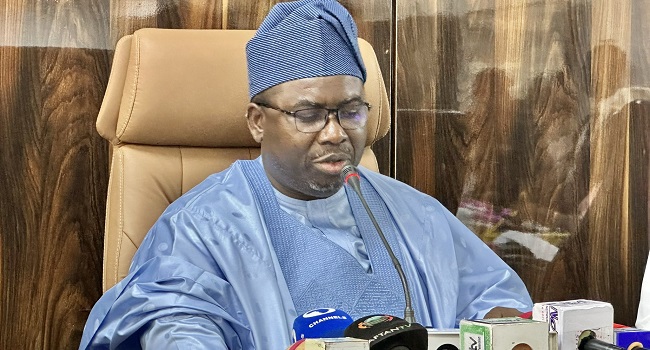
Thursday, November 12, 2026, Joash Amupitan, SAN, the law professor who is Chairman of INEC went to Chatham House in London to speak on a panel discussion titled “Nigeria’s 2027 Elections: Democratic Trajectory and Regional Stability Beyond the Ballot.” He went to explain, to answer, to be questioned. What met him outside was not questioning. It was ambush. Protesters surrounded his vehicle, blocked its path, hurled insults at him, and demanded his resignation. He was called a fraud, an agent of the ruling All Progressives Congress (APC), a man procured to return President Bola Tinubu in January 2027, willy-nilly.
Whatever one thinks of INEC, that scene should trouble every democrat. I hope insinuations that a few INEC officials who accompanied Amupitan to the engagement had APC campaign adornments on them are untrue. That would have been daft, insensitive, reckless, irresponsible, and unacceptable. But a man who had come to submit himself to public scrutiny was denied the dignity of being heard. The protest mistook the messenger for the malady. It revealed a deeper Nigerian habit: we personalise institutional failure until the person becomes the institution, and then we destroy the person in the hope that the institution will somehow heal itself. It never does.

Let us be clear, and let us be fair. The anger is not invented. It has a history, and it has a cause. Nigerians have watched elections disappoint them too often. They watched 2023 damage confidence in INEC in a way from which, by Amupitan’s own admission at Chatham House, the Commission has not yet fully recovered. They have now watched the discovery of suspected artificial intelligence-generated photographs and duplicate entries in the preliminary voters’ register. When citizens who went to verify their own names found strange faces staring back at them, it was not paranoia to ask questions. It was citizenship. On November 9, 2026, Amupitan himself gave the country the scale of the problem. After a review of the 2025/2026 Continuous Voter Registration (CVR) exercise, which harvested 11,088,238 records, INEC removed 1,608,660 invalid registrations. It removed a further 873 records belonging to verified deceased voters. It identified 54 persons across 10 states for alleged involvement in registration irregularities for disciplinary action and possible prosecution.
It admitted that some registration officers had abused their authorised access and that historical rot dating back to 2011 still clings to the register. That is a damning admission. But notice what it is and what it is not. It is not a cover-up. A Commission intent on rigging does not publish its own shame. It does not invite the public to display and object to its preliminary register from October 9 to 15. It does not announce that 268,000 cases were re-examined after public complaints, that 217,722 were found invalid and removed, while 50,278 were cleared and retained. It does not ban ordinary webcams for registration, approve an Artificial Intelligence Governance Framework, and promise a final register on December 15. A Commission intent on fraud conceals its fraud. This one, under Amupitan, exposed its own wound and began to clean it in public. This is the first test of objectivity: to distinguish between a problem discovered and a problem created.
The 1.6 million invalid entries, almost enough to have decided the vote difference between the presidential candidates of the APC and the Peoples Democratic Party, (PDP), in the 2023 election, are not Amupitan’s creation. Let’s be clear. They are the inheritance of a system that has been porous for years, exploited by low-level operators, distorted by new technology, and neglected by successive managements. To blame the man who found the rot for the existence of the rot is to punish the doctor for diagnosing the disease. The second test is performance. Amupitan has not merely talked about reform. He has run elections. Since his appointment in October 2025, he has delivered three off-cycle governorship elections in Anambra, Ekiti and Osun, alongside Federal Capital Territory Area Council elections and 16 legislative by-elections. In each governorship contest, the result reflected the popular will, and the outcomes cut across party lines: APGA in Anambra, APC in Ekiti, Accord in Osun.

A captured umpire does not produce results that embarrass the ruling party’s expectations in one state and confirm them in another. He produces a pattern. There has been no pattern here, except the pattern of results being declared promptly, in Anambra and Osun a day after voting, where such elections once dragged for days and ended in inconclusive agonies. Even more telling, as Amupitan promised the Senate when he was screened, losers congratulated winners. In a country where every election used to end in a tribunal, that is not a small thing. It is the beginning of a culture. That is how trust is rebuilt: not by grand speeches but by small, repeatable acts of competence. The third test is character. Amupitan did not seek this job as a politician seeks office. He lived and worked all his life in academia. He was a contented teacher wholly committed to instruction, research, and the unglamorous work of managing students, a department, and a faculty. He was sought out for the INEC hot seat. He did not climb to it.
He brings to the Commission the habits of the lecture room: evidence before assertion, procedure before passion, correction before concealment. At Chatham House, he remained in his vehicle and made no audible response to the invective. Some read that as arrogance. It was, in truth, restraint. And at that same session, he did something no recent INEC chairman has done so plainly. He pledged that he would not accept any appointment from anybody after his tenure because coming to serve is based on trust. In a country still smarting from the sight of his predecessor accepting a diplomatic posting after leaving office, that pledge was not rhetoric. It was a deliberate severing of the suspicion that INEC is a stepping stone to reward.
None of this means Amupitan is above criticism. He must be criticised and criticised relentlessly but criticised on evidence, in the proper forum, and with the aim of improving the election, not destroying the umpire. Opposition parties have every right to demand a clean register, to interrogate the 54 officials, to ask how historical duplicates will be purged, to monitor the nationwide mock accreditation on November 28, and to test the new safeguard that prevents an inaccurate polling-unit result from reaching IReV at all. That is oversight. That is democracy. What they do not have a right to do is to make the conduct of the election impossible by turning every controversy into a personal war against the chairman. If Amupitan spends his days answering one court injunction per day, responding to one manufactured scandal per day, defending his person against one mob per day, who will run the election? Distraction is not accountability. Harassment is not oversight.
A country that harasses its umpire into paralysis should not be surprised when the match is abandoned. Amupitan is, in many ways, a victim of our political imperfections. The anger that boiled over in London was not really about Amupitan. It was about 2023. Maybe also about 2019 when an opposition candidate was reportedly leading the presidential poll comfortably, and the INEC server developed a sudden “glitch,” which torpedoed popular expectations. It was about years of broken promises. It was about a feeling, shared by millions, that the vote does not count. Amupitan happened to be the man standing in front of the car when that anger needed a face. But if we allow that anger to consume the one man who is actually trying to fix the register, who is actually removing invalid names rather than defending them, then we will have committed a peculiarly Nigerian self-harm: we will have punished reform because it was not perfect, and in doing so, we will have made perfect reform impossible.
Let us, therefore, make a distinction our politics too often refuses to make: between INEC as an institution with a troubled history and Amupitan as a man with a short, verifiable record. Judge the institution by its history and demand that it change. Judge the man by his record and allow him to change it. To the opposition, I say this with respect: your strongest weapon in January 2027 will not be a protest in London. It will be a clean register, a vigilant polling agent, a credible result sheet, and a chairman who knows that the whole country is watching him. Give him the space to deliver that. Hold him to his own promises. Demand the final register on December 15 and audit it line by line. But let him work.
To the ruling party, I say this with equal candour: do not mistake an alibi on Amupitan’s behalf for a defence of yourselves. The best service you can render him is to leave him alone. Do not make his independence suspect by claiming him as yours. Nigeria does not need a perfect INEC chairman. It does not have one, and it never will. It needs an honest one, given the room to be honest, and held firmly to account for the honesty he promises. Amupitan has earned, by his short record, the right to be given that room. Let us stop heckling the man and start helping the process. The election is not his. It is ours. And if we break the umpire before the match, we will have no one to blame but ourselves when the game is lost.
Tunde Olusunle, PhD, Fellow of the Association of Nigerian Authors (FANA), is also a Fellow of the Nigerian Guild of Editors, (FNGE)