
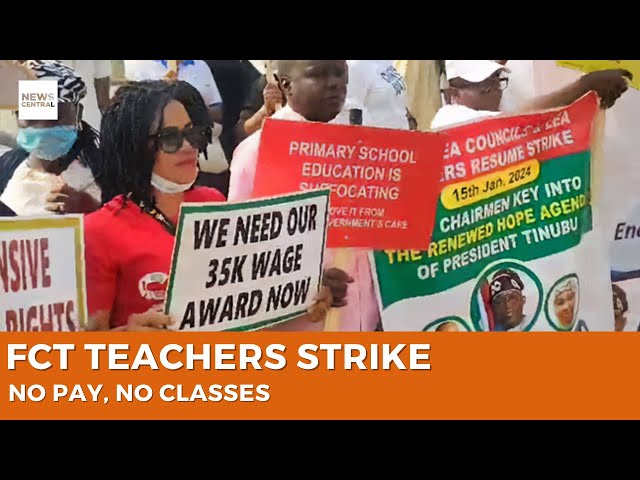


Public schools across the Federal Capital Territory have ground to a halt, throwing thousands of pupils into uncertainty, as the teachers’ strike deepens—triggering a fierce backlash from the Human Rights Writers Association of Nigeria (HURIWA) against FCT Minister, Nyesom Wike.
In a sharply worded intervention, the national coordinator of the group Comrade Emmanuel Nnadozie Onwubiko accused the minister of presiding over a growing education emergency, blaming what it described as a “dismissive and anti-worker approach” to the welfare of teachers and other public servants.
The group said the prolonged shutdown of schools is rapidly evolving into a social crisis, particularly for children from low-income families who rely solely on public education, warning that the longer the impasse lingers, the deeper the damage to the future of the territory’s young population.
Despite Abuja’s reputation as one of Nigeria’s most expensive cities, HURIWA lamented that many teachers remain poorly paid, overstretched, and neglected, describing the situation as a contradiction that reflects misplaced governance priorities.
The association argued that while visible infrastructure projects continue to dominate the administration’s agenda, the human foundation of development—education—has been dangerously sidelined.
“There is a dangerous imbalance when roads are rising but classrooms are empty,” the group noted, stressing that no meaningful development can take place when those responsible for shaping the next generation are left demoralized.
HURIWA also took aim at what it called the widening disconnect between political leaders and ordinary citizens, highlighting the stark contrast between elite access to quality education and the deteriorating state of public schools.
According to the group, the crisis is not just about unpaid salaries but about the broader failure to prioritize education as a strategic tool for national development and social stability.
Warning of far-reaching consequences, HURIWA said prolonged disruption of schooling could fuel inequality, increase youth vulnerability, and heighten social tensions in the long term.
It called for immediate action to resolve the impasse, including the payment of outstanding entitlements, meaningful engagement with teachers, and a broader commitment to improving welfare conditions in the education sector.
As classrooms remain locked and academic activities stalled, pressure is mounting on the FCT Administration to act swiftly—before what began as a labour dispute transforms into a full-blown societal crisis.