
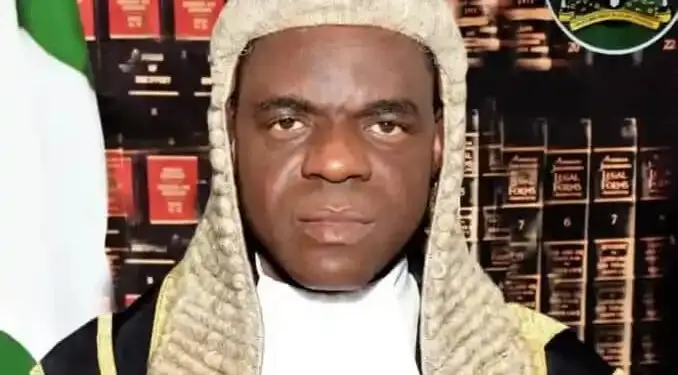

The internal power struggle rocking the African Democratic Congress (ADC) has taken a sharper legal turn, with party chieftain Mr. Nkemakolam Ukandu asking the Federal High Court in Abuja to remove Justice Liman Suleiman from presiding over a high-stakes leadership dispute.
In a motion filed on March 26, 2026, before the court, Ukandu accused the judge of actions that, in his view, raise serious concerns about impartiality and fair hearing. He argued that the handling of the case—filed under suit number FHC/ABJ/CS/1637/2025—has created a situation where he may not obtain justice if the same judge continues to preside.
Through his counsel, Kalu Kalu Age Esq, Ukandu is seeking two key reliefs: that the case file be returned to the Chief Judge of the Federal High Court for reassignment, and that proceedings be halted pending the outcome of the recusal request.
Central to his complaint is the allegation that some applications were heard and granted without proper service of hearing notices on his legal team—an action he says undermines due process and strips the court of the authority to proceed on such applications.
In a supporting 26-paragraph affidavit, Ukandu escalated the allegations further, claiming that some of the judge’s rulings appear to favor interests aligned with political figures, including the Minister of the Federal Capital Territory, Nyesom Wike. He warned that such perceptions, if left unaddressed, could erode public confidence in the judiciary and destabilize opposition politics.
The court battle stems from a broader internal crisis within the ADC. At the center of the dispute is a suit filed by Hon. Leke Abejide, a member of the House of Representatives, challenging the process that brought Senator David Mark and others into the party’s leadership structure. Although Abejide has since been expelled from the party over alleged anti-party conduct—including his reported support for President Bola Tinubu’s re-election—he has continued to pursue the case in court.
Ukandu, who now serves as the party’s welfare secretary, has aligned with the current leadership while simultaneously raising concerns about the integrity of the judicial process handling the matter. His latest move signals a deepening mistrust and a widening rift within the party’s ranks, where political disagreements are now playing out in the courtroom.
The case underscores a recurring tension in Nigeria’s political system—where internal party disputes frequently escalate into legal battles that test not only party cohesion but also the credibility of the judiciary.
As the matter unfolds, attention is now fixed on the Federal High Court to determine whether Justice Suleiman will step aside or continue presiding over a case that has become a focal point in the ADC’s internal crisis and a broader test of institutional confidence.