
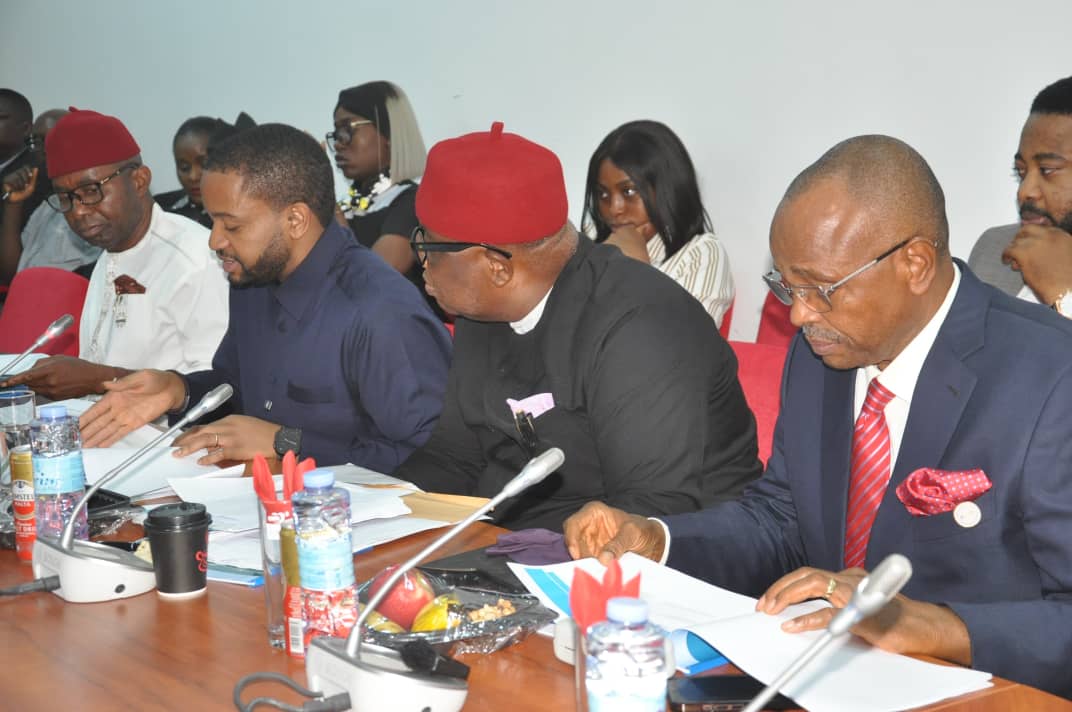


The Senate has opened a sweeping probe into the finances of the South East Development Commission (SEDC), raising concerns over what lawmakers described as questionable spending patterns and inadequate financial disclosures barely months after the intervention agency commenced operations.
At the centre of the controversy is the commission’s utilisation of N16.6 billion released from its 2025 budget allocation, with members of the Senate Committee on the South East Development Commission demanding explanations for billions of naira already expended and directing the agency to produce detailed records of all transactions.
The development has cast a spotlight on the management of one of Nigeria’s newest regional development agencies, established to accelerate infrastructure renewal, economic growth and post-conflict reconstruction across the South-East.

During an investigative hearing in Abuja, lawmakers questioned expenditures contained in the commission’s financial report, including N153 million reportedly spent on renting a liaison office in the Federal Capital Territory and N2.5 billion listed under what committee members described as unclear expenditure classifications.
Chairman of the committee, Senator Orji Uzor Kalu, said information available to the panel indicated that while the commission received N16.6 billion in December 2025, only about N13 billion remained in its accounts, suggesting that approximately N3.6 billion had already been spent.
He faulted the financial report presented by the commission, describing it as unsatisfactory and inadequate for legislative scrutiny.
“This committee is disappointed with the financial report given, which is completely unacceptable,” Kalu declared.
The committee’s concerns were echoed by other lawmakers, including Senators Enyinnaya Abaribe, Victor Umeh and Austin Akobundu, who argued that the commission had failed to provide sufficient details to justify some of its expenditures.
For many lawmakers, the issue goes beyond accounting discrepancies. It raises broader questions about governance, transparency and fiscal discipline within an agency expected to play a pivotal role in addressing decades of infrastructure deficits and economic neglect in the South-East.

The Senate’s intervention comes at a critical time when expectations are high for the commission to deliver visible development projects across the region.
Defending the commission, Managing Director Mark Okoye insisted that all expenditures had been made responsibly and in line with available resources. He explained that the agency was deliberately avoiding the common practice of awarding contracts beyond actual cash releases.
According to him, budgetary allocations should not be confused with funds available for immediate spending.
“Our approach has been to ensure that available resources are directed towards priority projects. We want allocations to guide the procurement process so that contracts awarded can be backed by available funding,” he said.
Okoye maintained that committing the commission to projects without corresponding cash backing would create financial liabilities capable of undermining its long-term sustainability.
However, the explanations failed to convince lawmakers, who insisted that every expenditure must be supported by verifiable documentation.
Consequently, the committee directed the commission to submit complete financial records, including details of contracts awarded, payment schedules, procurement documents and all supporting evidence relating to expenditures made from the funds released.
The Senate gave the commission until June 23 to provide the documents and indicated that the outcome of its review would determine the next phase of the investigation.
With the probe now underway, attention has shifted to whether the commission can satisfactorily account for the funds already spent and reassure stakeholders that resources meant for the development of the South-East are being managed with transparency and accountability.
The unfolding scrutiny signals a determination by lawmakers to subject the commission’s operations to rigorous oversight as it begins the task of driving development in the region.