
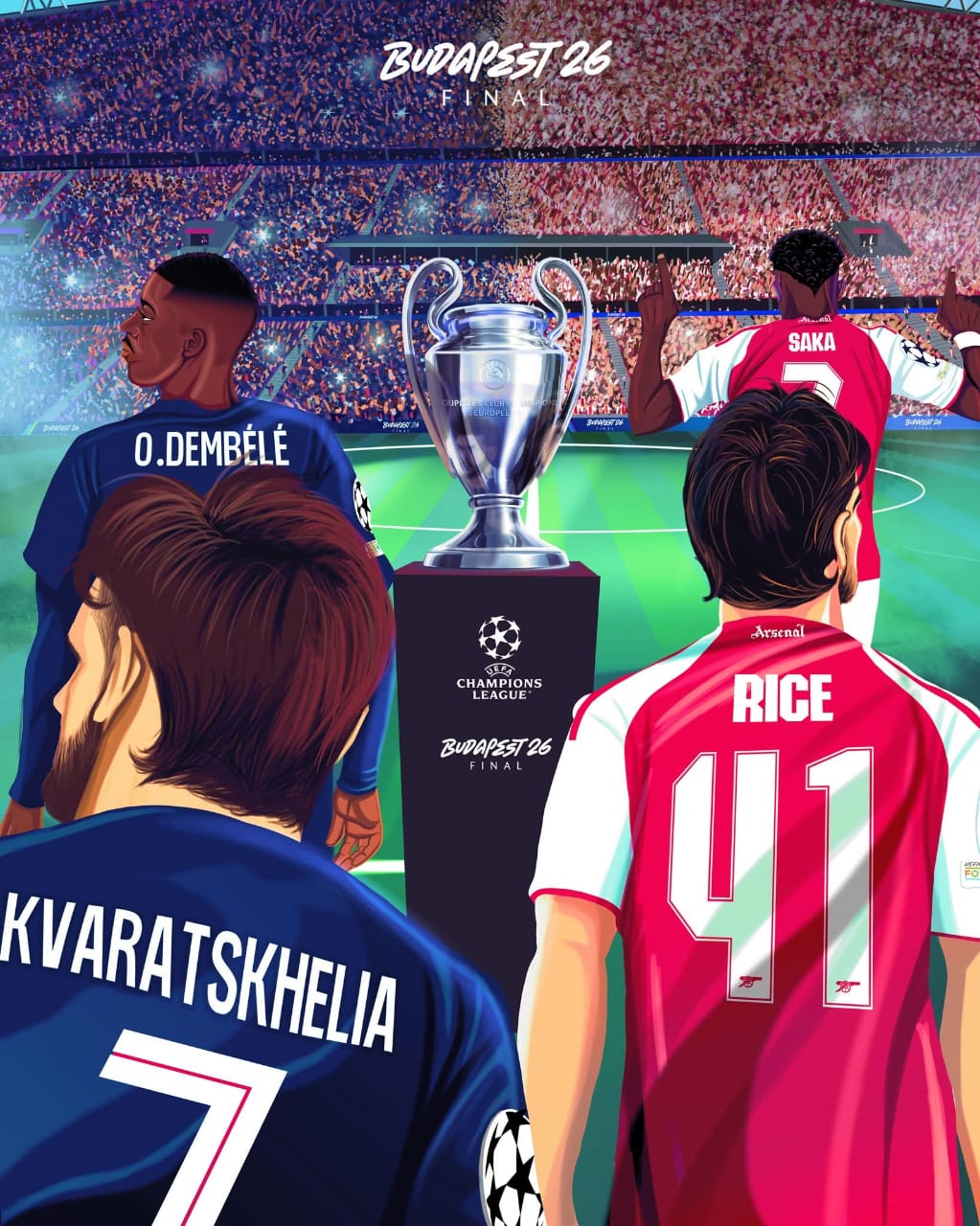


By Douglas Baye-Osagie
The curtain closes on the 2025/2026 European club football season tonight. The champions of England, Arsenal, face the champions of France, Paris Saint-Germain. This is a final, and anything can happen. One moment of brilliance, one defensive lapse, one refereeing decision can change everything. Form goes out the window when the whistle blows in Budapest.
A lot has been said coming into the final, but one player who has dominated the headlines is the crown prince of football, the Ballon d’Or holder, Ousmane Dembélé. Under Luis Enrique, he finally combined flair with discipline and became PSG’s most decisive attacker.

The 2025-26 campaign has been different. Injuries and careful management have limited his minutes. He played just 22 league games, started only 11, and scored 10 league goals. He was substituted 11 times. Luis Enrique has used him more sparingly, prioritizing preservation over burnout.
The drop in league starts isn’t a decline in influence. It’s a deliberate trade-off. PSG had the league wrapped up early, so the focus shifted to keeping him fresh for Europe.
That plan paid off in the Champions League. Dembélé’s performances have arguably been more impactful in Europe than domestically. He has 7 goals and 2 assists in 12 UCL appearances, and his output in big games remains elite.
His early goal in the return leg against Bayern Munich earned PSG a 1-1 draw and sent them through 6-5 on aggregate. That strike put PSG in a second straight final and highlighted how Luis Enrique’s system gets the best out of him when it matters.
Luis Enrique’s system helped make it possible. PSG stopped relying on individual brilliance and played as a positional machine. Dembélé was given freedom on the right, but also a clear defensive responsibility. He ran more off the ball than he ever had in his career, making him the leader of the press when the team wants to regain possession.
Over the past three seasons, PSG’s domestic dominance through effective squad rotation has given them that extra bit of freshness in Europe. The league became a training ground, a place to rotate, rest, and rehearse patterns without pressure.
Luis Enrique rotated his front line relentlessly. No one felt indispensable, and no one was overplayed. The squad stayed sharp and hungry.
This was a deliberate strategy. PSG had been burned before by peaking too early and running out of steam in Europe. This time, they kept their gunpowder dry. The league was secured early so the Champions League could be the focus.
By the semifinals, PSG looked like the most balanced side in the competition. They pressed as a unit, defended in a 4-3-3, and countered with terrifying speed. Dembélé was central to that balance, offering both a goal threat and a defensive outlet.
On the other side, Arsenal arrive in the final with a different story. They’ve played beautifully all season under Mikel Arteta, winning the Premier League and arriving in the Champions League final unbeaten in Europe. But there’s a weight they carry.
Arsenal have never won a European trophy. The club’s history in finals is haunted by 2006 in Paris, by near misses in the Europa League, and by the feeling that something always goes wrong when it matters most. This curse has to be broken someday, and the football gods might smile on them tonight.

That history matters, even if players say it doesn’t. Young squads can feel the absence of precedent. When the game gets tight in the 85th minute, doubt creeps in. It’s the difference between a club that expects to win and one that hopes to.
For Declan Rice, Bukayo Saka, Martin Ødegaard and the rest of the boys, this is uncharted territory. They’ve ended Arsenal’s 22-year wait for a domestic league title. But breaking a European curse is a different kind of pressure. PSG, for all their past failures, have been here before in 2020 and again last year.
Luis Enrique knows how to manage that mental game. He won the Champions League with Barcelona and again last season with PSG. He will remind his players that finals are not won by history, but by moments. One press, one pass, one finish.
Paris Saint-Germain’s bid to retain the Champions League pits them against a multifaceted Arsenal side intent on raining on the Parisians’ parade.
Luis Enrique’s side made a slow start to their title defence but have found a different gear since a closely fought knockout playoff round against Ligue 1 challengers Monaco.
Since beating the side from the Principality, PSG have made light work of two English opponents — Chelsea and Liverpool — and then overcame Bayern Munich in what will go down as one of the most thrilling Champions League semi-final ties.
Arsenal’s advantage is their unity and hunger. This group has grown together for three years. They don’t fear PSG’s names. They believe in their process, and their pressing has dismantled better teams than PSG this season.
But belief without experience can fray under the weight of a final. PSG’s players have felt the sting of losing in Europe. They know how quickly a game can slip away. That scar tissue can be a strength if managed well.
The tactical battle will hinge on the wings and the midfield, with PSG’s Portuguese duo of Vitinha and Neves bringing memories of the legendary Spanish Xavi and Iniesta partnership. Declan Rice will have a lot of cleaning up to do today. If Arsenal, still unbeaten in this season’s Champions League, can contain PSG’s midfield with a disciplined tactical approach, they can blunt PSG’s transition game.
If there is any Arsenal team that can break the curse, it’s this one. They are young, fearless, and coached by a man who learned under Pep. They play with clarity and courage that deserve a European trophy.
The London side’s ability to win ugly is balanced by an innate capacity to dictate tempo in possession, as demonstrated in their composed early goal against Atlético Madrid in the semi-finals.
By blending physical dominance from set pieces with sophisticated tactical rotation in midfield, Arteta has constructed a multifaceted machine capable of navigating any match scenario.
But they face a PSG side built for this exact night. A team that sacrificed domestic minutes to be fresh here. A team with Dembélé, even with fewer starts, still capable of deciding finals. A team coached by a man who knows how to win this competition.
This evening in Budapest, PSG’s cold, calculated preservation faces Arsenal’s relentless, emotional charge. One will end a drought. The other will extend it.
In finals, history whispers. But it doesn’t decide. That will be left to 22 players, and to whether Dembélé’s legs still have one more burst, and whether Arsenal’s belief is stronger than their past.