

By Lemmy Ughegbe, Ph.D.

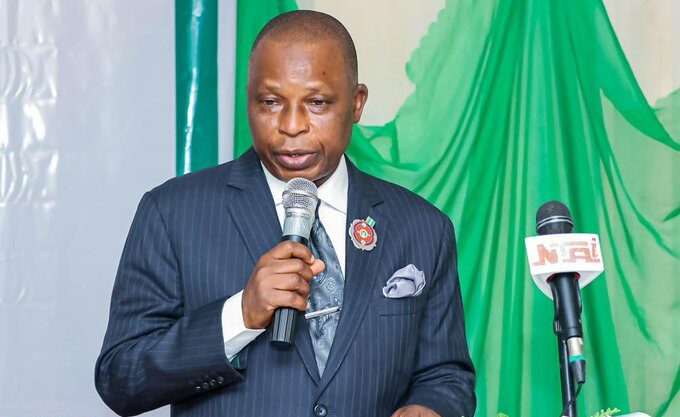
In Nigeria, Chief Law Officers have not always been remembered for reforming the justice system; some courted controversy, others defended governments rather than the law, and a few left only faint footprints. Prince Lateef Olasunkanmi Fagbemi, SAN, appears determined to write a different story.
Since assuming office as Attorney General of the Federation and Minister of Justice in August 2023, Fagbemi has largely resisted turning the role into a political megaphone, focusing instead on institutional reform and the justice system’s structural weaknesses.
This matters because the Attorney General is simultaneously chief legal adviser to the Federal Government and the nation’s Chief Law Officer. Its successful occupant understands that governments come and go, but the rule of law must endure.
One defining feature of Fagbemi’s tenure has been an attempt to reposition justice administration around institutions rather than personalities. Its clearest expression is the National Policy on Justice 2024–2028, adopted at the National Summit on Justice in April 2024, setting out objectives including human rights protection, access to justice for the poor and vulnerable, speedier justice delivery and stronger federal-state cooperation.
That may sound bureaucratic, but Nigeria’s justice crisis has never principally been about the absence of laws; the country has an impressive collection of statutes, precedents and constitutional guarantees. The greater problem has always been implementation, institutional fragmentation and the gulf between justice as written and justice as experienced.
This explains the significance of National Minimum Standards for implementing the Administration of Criminal Justice Act 2015 and equivalent state laws, intended to reduce the wide variation in criminal procedure across jurisdictions and tackle court congestion, delayed trials and weak inter-institutional coordination.
Fagbemi’s Ministry has also confronted obsolete legislation, inaugurating a 46-member committee in October 2024 to review and update outdated Nigerian laws that a modern justice system cannot efficiently operate under.
No single intervention illustrates Fagbemi’s institutional instinct better than the Supreme Court suit he filed in May 2024, on behalf of the Federal Government, against the Attorneys General of the 36 states (Suit No. SC/CV/343/2024), challenging state control of funds constitutionally due to local governments and the use of unelected caretaker administrations.
On 11 July 2024, the Supreme Court substantially upheld the case, ordering that allocations due to democratically elected local governments be paid directly to them and rejecting caretaker structures as unconstitutional. It remains the most consequential legal intervention of his tenure: a rare case of the Federal Government using litigation against entrenched state practices, even in states his own party controls.
Yet victory in court has not meant victory in practice. Two years on, Federation Account figures show approximately N10.48 trillion allocated to local governments between July 2024 and June 2026, but direct financial autonomy remains largely stalled, with states still controlling council finances.
Fagbemi won the case and later warned governors against contemptuous conduct, yet the gap between judgment and implementation shows the limits of litigation against political resistance to reform. Whether Nigeria’s federal structure absorbs its full consequences will be one of the enduring tests of his tenure.
There are measurable outcomes elsewhere. In May 2025, Fagbemi reported more than 1,300 convictions secured across offence categories: 226 from 237 terrorism cases tried in December 2024, 1,056 drug related convictions through the National Drug Law Enforcement Agency, and 37 human trafficking convictions recorded by the National Agency for the Prohibition of Trafficking in Persons.
The terrorism prosecutions matter particularly, given years of suspects held in prolonged detention without trial, a national security and human rights problem alike; judicial determination, however imperfect, beats indefinite detention.
Asset recovery has also progressed. On 10 January 2025, Nigeria signed an asset sharing agreement with the United States that repatriated $52,882,018.95 in Galactica assets. The Ministry also gazetted regulations under the Proceeds of Crime framework and developed a National Database on Asset Recovery and Management to improve transparency.
But recovery is only half the story; the real test is whether recovered assets are transparently managed and benefit the public. Nigeria’s history here has generated almost as many questions about what happened after repatriation as about how the assets were stolen, so Fagbemi gets plaudits for a database that should be an instrument of genuine accountability, not another announcement-only portal.
There is also an access to justice dimension. The Legal Aid Council, per the Attorney General’s figures, handled 2,790 criminal cases and 1,021 civil matters, 482 of them resolved through Alternative Dispute Resolution, alongside 637 police station interventions and 760 visits to correctional centres.
These numbers may matter more to ordinary Nigerians than grand pronouncements about judicial reform. For a poor citizen arrested without representation, access to a lawyer can mean the difference between justice in theory and justice in reality.
Yet any assessment of Fagbemi’s stewardship must resist canonisation. Nigeria’s justice system remains burdened by unacceptable delays: correctional facilities still hold large numbers of awaiting trial inmates, cases take years to conclude, and enforcement of judgments remains problematic, with public institutions sometimes disobeying court orders. A wider crisis of confidence in the judiciary persists that no Attorney General, however competent, can resolve alone.
Fagbemi’s reforms must be judged not by policies produced, committees inaugurated or communiqués issued, but by what changes in the lived experience of Nigerians seeking justice. Can the poor obtain justice against the powerful? Can an arrested citizen expect constitutional protections to be respected? Can trials proceed without interminable adjournments? And, most fundamentally, can government itself consistently submit to the authority of the law? These are the tests that will determine the value of the reforms now underway.
There is something refreshing about an Attorney General whose profile has been defined more by institutional reform than political combat. Nearly three years into his tenure, enough has happened to permit an interim assessment. The verdict cannot yet be final, but the direction is encouraging.
The challenge now is consolidation. Fagbemi must ensure the architecture he has built survives personalities and political transitions: national policies must become measurable outcomes, databases must become instruments of transparency, and criminal justice reforms must reach police stations, correctional centres and courtrooms. Legal aid must reach those who cannot afford representation, the law review must end in actual repeal, and the local government judgment must not become a victory defeated by political manoeuvring.
Government, too, must show that respect for the rule of law binds those who exercise state power as firmly as it binds citizens.
If Fagbemi succeeds in institutionalising these principles, his greatest accomplishment may not be any single prosecution, asset recovery, Supreme Court victory or piece of legislation. It may be that he helped restore to the office of Attorney General its proper constitutional character: not simply the lawyer of the government of the day, but a guardian of legality and custodian of the public interest.
In a country where loud political performance frequently overshadows quiet institutional work, that would be no small legacy.
Lemmy Ughegbe, Ph.D, FIMC, CMC
Email: lemmyughegbeofficial@gmail.com
WhatsApp ONLY: +234 806 971 6645