
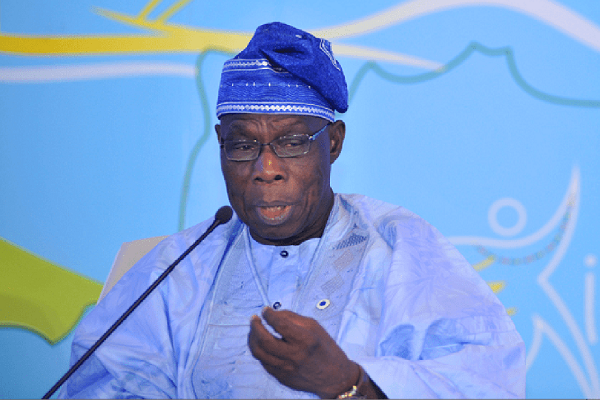


Former President Olusegun Obasanjo has questioned the human cost of President Bola Tinubu’s economic reforms, arguing that the sharp depreciation of the naira has eroded Nigerians’ purchasing power and intensified the struggle to afford basic necessities.
Speaking on Wednesday at the 2026 Financial Times Africa Summit in London, Obasanjo challenged the consequences of allowing the naira to fall sharply against the dollar, saying the impact had been felt far beyond the foreign exchange market.
“We do not live in isolation as a country. We interact with the rest of the world. And overnight, you devalue the currency by 300 per cent. The naira went from N500 to a dollar to N1,500 to a dollar,” he said.

“What that meant was that every Nigerian is made poor by 300 per cent. That made Nigeria become the poverty capital of the world,” the former president added.
His remarks have brought renewed attention to a central question surrounding the Tinubu administration’s economic programme: how much hardship should households endure while government pursues policies designed to correct longstanding economic distortions?
Tinubu removed the petrol subsidy in May 2023 and introduced foreign exchange reforms the following month. The measures were intended to reduce market distortions, improve currency allocation and attract investment.

But the weaker naira has made imported goods and inputs more expensive, while higher fuel and transportation costs have added to the pressure on household budgets and business operations.
For many Nigerians, the effects of these changes are experienced through everyday spending — from food and transport to medicines, school expenses and other essentials.
The debate, therefore, extends beyond whether the reforms were intended to stabilise the economy. It also concerns whether their benefits can reach ordinary households quickly enough to ease the pressure on incomes and living standards.
Obasanjo’s claim that every Nigerian became poorer by 300 per cent is a broad rhetorical assessment, not a direct statistical measurement of individual poverty. The effect of currency depreciation varies according to income, spending patterns, access to foreign exchange and whether a person or business earns in naira or foreign currency.
The government’s policy direction also reflects an effort to address structural weaknesses in the economy, although the immediate effects of subsidy removal and currency depreciation have fuelled public concern over affordability.
The challenge now is whether economic stabilisation can translate into more affordable essentials, stronger purchasing power, improved employment opportunities and rising real incomes.
Obasanjo’s intervention has placed that test of economic reform — its impact on the daily lives of Nigerians — back at the centre of the national debate.