
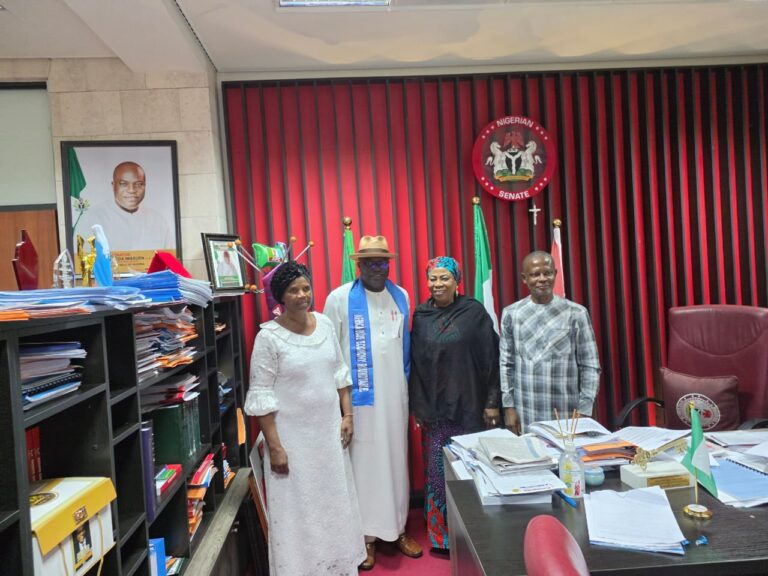


Senator representing Edo South, Neda Imasuen, has pledged to champion stronger legislative action to protect Nigeria’s marine resources and harness the economic potential of the blue economy amid revelations that illegal fishing costs West Africa an estimated $2.3 billion annually.
Imasuen warned that illegal, unreported and unregulated fishing was not only draining the region’s maritime wealth but also threatening the livelihoods of coastal communities that depend on fishing for survival.
He spoke when a delegation of the Africa Blue Economy Roundtable (ABER), led by its Founder and Convener, Dr Piriye Kiyaramo, visited him at the National Assembly in Abuja on Tuesday.

The senator promised to mobilise legislative support for the development of the blue economy, including facilitating engagements with relevant Senate committees to strengthen policies and laws governing the maritime sector.
He also accepted to serve as a Patron of ABER.
During the meeting, Kiyaramo disclosed that West Africa loses about $2.3 billion annually to illegal fishing, while more than 70 per cent of artisanal fishers reportedly venture into the sea without basic safety equipment.
He further revealed that over 90 per cent of fisherfolk lack access to legal assistance and effective channels for reporting abuses, describing the situation as a Blue Justice Gap in the Gulf of Guinea.
The ABER convener called for urgent interventions to protect vulnerable fishing communities and ensure that coastal populations benefit from the economic resources surrounding them.

Responding, Imasuen described the Niger Delta’s coastline, beaches and marine resources as largely untapped economic assets capable of attracting investment, generating employment and stimulating development.
He identified coastal tourism, marine transportation, sustainable fisheries and aquaculture as sectors that could open new economic opportunities for the region.
The lawmaker commended Bayelsa State Governor, Senator Douye Diri, for establishing a dedicated Ministry of Marine and Blue Economy, urging other coastal states to adopt similar institutional arrangements to drive development in the sector.
He noted that Nigeria’s 853-kilometre coastline, alongside Edo State’s access to the Atlantic Ocean through its riverine communities, presented enormous opportunities that should not be allowed to remain untapped.
Imasuen also advocated strict enforcement of the five-nautical-mile Artisanal Exclusive Zone to safeguard small-scale fishers against illegal fishing activities by larger operators.
He called for investment in cold-chain storage facilities, particularly to support women involved in fish processing, reduce post-harvest losses and improve their earnings.
Earlier, Kiyaramo explained that ABER was a Pan-African initiative operating under the BRACED Tourism Promotion and Development Initiative, with offices in New Jersey and California in the United States and a liaison bureau in Abuja.
Also speaking, the organisation’s Director of Policy and Advocacy, Women’s Forum, Dr Mrs Ezeadili Appolonia Obiageri, and Director of Communication and Public Affairs, Hajiya Medina Dauda Nadabo, commended Imasuen for his contributions and commitment to national development.