
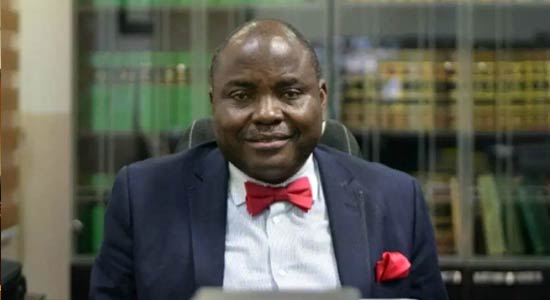


Senior Advocate of Nigeria, Jibrin Samuel Okutepa, has warned Nigerian courts against treating confessional statements as automatic proof of guilt, insisting that no one should be convicted of an offence that credible evidence shows never occurred.
Okutepa said even a voluntary and unequivocal confession could not replace the prosecution’s constitutional obligation to prove the commission of an offence and the accused person’s involvement beyond reasonable doubt.
In a legal commentary published on Wednesday, November 25, 2026, the senior lawyer distinguished between admitting a confession as evidence and establishing the truth of its contents.

He illustrated the point with a hypothetical murder case, asking whether a person could be convicted of killing someone who was subsequently established to be alive simply because he confessed to the murder.
His position was that a confession could not create a crime that never happened.
While acknowledging that Nigerian law permits conviction on a credible confession without independent corroboration, Okutepa cautioned that courts must still examine its reliability against the facts and circumstances of each case.
He cited Sections 28 and 29 of the Evidence Act 2011, which define confessions and provide safeguards against statements obtained through oppression or circumstances that render them unreliable.
The SAN also referenced the Supreme Court decisions in Fatai Busari v. The State, SC.364/2012, and Kasa v. The State (1994) 5 NWLR (Pt. 344) 269, to reinforce the need for courts to scrutinise confessional statements rather than accept them unquestioningly.

He further cited the judicial tests in R. v. Sykes (1913) 8 Cr. App. R. 233, which require courts to examine whether a confession is possible, consistent with established facts and supported by circumstances surrounding the alleged offence.
Okutepa, however, distinguished cases where a victim’s body has not been recovered from situations where credible evidence establishes that the supposed victim is alive.
He explained that failure to recover a body does not automatically defeat a murder charge where other credible evidence establishes that death occurred and the accused was responsible.
But where evidence affirmatively establishes that the alleged criminal event never happened, he argued, a confession alone cannot sustain a conviction for that offence.
He also cautioned that an accused person’s subsequent denial does not automatically invalidate an earlier confession, saying courts must evaluate both statements alongside the totality of the evidence.
The senior lawyer maintained that criminal trials must be decided on established facts, not merely on an accused person’s admission of responsibility.
“Criminal justice determines guilt from proved facts; it does not punish a person simply for claiming responsibility for an imaginary crime,” he said.
He insisted that the prosecution must prove that the offence actually occurred and that the accused committed it, regardless of how incriminating a confessional statement may appear.