


By Douglas Baye-Osagie
“If the stadiums are empty, the training pitches are poor, and even the airports feel like obstacles, then what are we really celebrating?” Uruguay coach Marcelo Bielsa’s frustration still echoes. Everyone is complaining about poor facilities, organization, and logistics replacing the discussion about the superstars and football teams participating
The fears of football fans for about a year have come alive. America’s visa measures have made it difficult for lovers of the game to enter, follow their teams, and enjoy the World Cup atmosphere. We just hope that when the football actually starts, the same won’t be said.

Ticket cost is the first wall. The energy of the game comes from fans who leave their workplace to follow the action. The passionate fans should not be cut off because of money. Group-stage prices have already been called “unusual and inflated” by supporters. Football stops being a working-class game and becomes a luxury product when the men in suits outnumber the men in shorts and singlets inside a stadium.
Pele played in bare feet. Maradona came from the villas. If FIFA turns the World Cup into an event only bankers can attend, then it has forgotten its own history. Football is one of the few sports you begin with just passion, not the pressure of buying boots or gear. You kick plastic balls and use stones for goalposts. That’s how close the game is to the commoner.
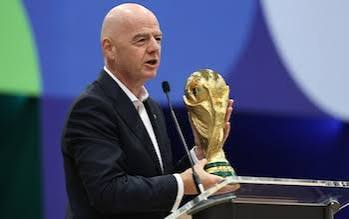
In 2017, FIFA President Gianni Infantino was clear during the 2026 bidding process:
“Teams who qualify for a World Cup need to have access to the country, otherwise there is no World Cup. That is obvious… any team, including the supporters and officials of that team, who qualify for a World Cup need to have access to the country, otherwise there is no World Cup.”
He said the bid requirements would be clear. Each country could decide if it wanted to bid based on those requirements. Access was non-negotiable.
Fast forward to 2026 and the contrast is uncomfortable. We can see entire squads like Senegal and Uzbekistan subjected to invasive searches on arrival; Africa’s best referee, Omar Artan from Somalia, turned back despite diplomatic documents; an Iraq team photographer denied entry with a valid visa; AIPS raising alarm over visa issues for African and Iranian journalists; claims that 90% of Moroccan ticket-holders were denied entry; and 14 Iran backroom staff refused visas. This has been a very embarrassing way to start the World Cup.
Infantino’s 2017 standard was simple: qualify, and you get in. No asterisks. No extra hurdles. The pitch must be neutral ground, separate from politics. But in 2026 he says he can’t control who comes in or who is allowed entry into a country. Hypocrisy at its highest level.
Marcelo Bielsa’s warning about “detention of players, photographers, referees, coaches, and just about everything else” points to what happens when organization fails. When suspicion grows, people stay home.
2026 will be the biggest World Cup ever – 48 teams, 104 matches. Bigger should mean more inclusive. But scale without planning becomes chaos. And chaos kills atmosphere.

Fans are doing the math. Five-hour flights between US cities. Expensive hotels. Expensive tickets. Hard to get leave. Add entry uncertainty, and the equation tells fans: watch from home. This is the painful reality.
I hope that’s not how we get “the worst World Cup edition ever” – not from bad football, but from distance between the game and the people. Football without crowds is just training with cameras.
USA stadiums are world-class for NFL and concerts. But football needs safe standing, affordable tickets, and fans close to the pitch. A 70,000-seat NFL bowl filled with tourists is not the Maracanã.
Training facilities matter too. Players live at those bases more than in stadiums. Poor pitches equal poor recovery equals poor performance. Bielsa, obsessed with detail, sees it first.
Airports are the first touchpoint. First impressions last. If accreditation is hell and equipment is delayed, the tournament’s story starts badly.
And when qualified participants allegedly face barriers to entry, the competition loses integrity. Infantino said it himself in 2017: “otherwise there is no World Cup.”
This is why the debate about future hosts matters. Football should return more often to countries that celebrate it as culture, not just commerce. Where kids play in the street and stadiums are full on Wednesday nights.
Argentina, Brazil, Morocco, Nigeria, Turkey, Spain – places where the game lives in the air. Hosting there doesn’t guarantee perfection, but it guarantees passion. Passion fills gaps money cannot.
Let 2026 be a lesson. Infantino set the standard in 2017: access first. The next bids should go to nations that breathe football daily. Because a World Cup without the fans is just a match. And football has always belonged to the people in the stands.
As Thierry Henry puts it: “I still believe the World Cup will produce incredible moments, but FIFA must make sure that football remains the main story. Politics has enough stages already; the football pitch shouldn’t be one of them.”
Let’s hope this betters Qatar 2022. We had a few worries then too, but once the football started we all focused on the football. That’s all we’re asking for now.