


By Abdulkarim Abdulmalik
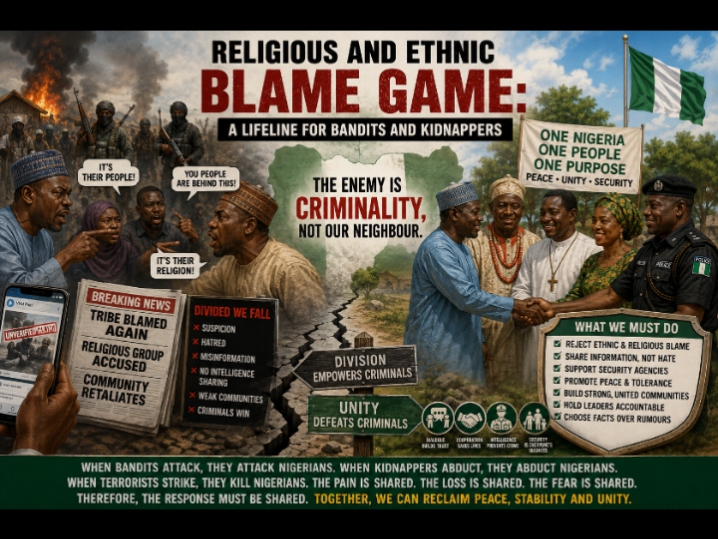
At a time when Nigerians should be standing shoulder to shoulder against insecurity, many are unfortunately turning against one another. Every major security incident is increasingly followed by a familiar pattern: accusations, counter-accusations, ethnic profiling, and religious finger-pointing.
A village is attacked, and before security agencies complete their investigations, social media courts have already delivered judgments. A kidnapping occurs, and entire ethnic groups are blamed. A terrorist attack takes place, and religious sentiments immediately overshadow objective analysis.

While such reactions may be driven by anger, grief, and frustration, they are also giving criminals exactly what they want.
Bandits, kidnappers, and terrorists thrive when societies are divided. Nothing serves their interests better than a nation whose citizens are busy blaming one another instead of confronting the real enemy.
The painful reality is that insecurity in Nigeria has no tribe and no religion.
The victims of kidnapping are Muslims and Christians alike. Bandits attack communities without asking for ethnic identity cards. Terrorists do not spare worshippers in mosques, churches, markets, schools, or motor parks. Their violence affects everyone. Their bullets do not discriminate. Their ransom demands do not consider religion.
Yet, despite this obvious reality, many Nigerians continue to view security challenges through ethnic and religious lenses.
This trend is becoming increasingly dangerous.
When insecurity is reduced to a contest between tribes or faiths, attention shifts away from the criminals themselves. Public conversations become emotional rather than factual. Genuine security concerns become politicized. Communities that should be cooperating begin to distrust one another.
And in that atmosphere of suspicion, criminals find room to operate.
Security experts across the world agree on one fact: no government can successfully fight insecurity without the cooperation of its citizens. Intelligence gathering remains one of the most effective weapons against criminal networks. Information from local communities often helps security agencies prevent attacks, rescue victims, and dismantle criminal hideouts.
But intelligence sharing becomes difficult when citizens are divided by suspicion.
Imagine a community where neighbours no longer trust one another because of ethnicity or religion. Imagine villages where people are unwilling to share information because they fear being misunderstood or accused. Imagine a nation where every security operation is interpreted through the prism of identity politics.
Such conditions do not weaken criminals; they strengthen them.
Nigeria’s enemies understand this very well.
Criminal groups know that a divided society is easier to exploit. They know that once public attention shifts to ethnic and religious arguments, pressure on criminal networks reduces. Instead of focusing on identifying perpetrators, citizens become occupied with defending their identities and attacking others.
That is why Nigerians must resist the temptation to generalize.
No ethnic group should be criminalized because of the actions of a few individuals. No religion should be blamed for crimes committed by criminals. To do so is not only unfair; it is counterproductive.
Every ethnic group in Nigeria has produced heroes and villains. Every religious community contains law-abiding citizens and lawbreakers. Criminality is a personal choice, not an ethnic inheritance or religious obligation.
This is where leadership becomes crucial.
Political leaders must avoid inflammatory statements capable of worsening tensions. Religious leaders should continue preaching peace, tolerance, and national unity. Traditional rulers must strengthen dialogue among communities and encourage cooperation with security agencies.

The media also has a vital responsibility.
In today’s digital age, a single misleading headline can spread across the country within minutes. Unverified claims can fuel fear and resentment. Journalists must therefore remain committed to professional ethics, responsible reporting, and fact-based analysis.
Nigeria has already paid a heavy price for division.
For decades, ethnic and religious tensions have distracted the nation from addressing many of its real challenges. Instead of building consensus, citizens often retreat into competing camps. Instead of seeing themselves first as Nigerians, many choose narrower identities.
But insecurity should remind us of a simple truth: when bandits attack, they attack Nigerians. When kidnappers abduct travellers, they abduct Nigerians. When terrorists strike communities, they kill Nigerians.
The pain is shared. The loss is shared. The fear is shared.
Therefore, the response must also be shared.
This is not the time for mutual suspicion. It is not the time for inflammatory rhetoric. It is not the time for narratives that divide communities already struggling under economic hardship and security pressures.
Rather, this is the time for national solidarity.
Citizens should support legitimate security efforts by providing useful information, remaining vigilant, and cooperating with law enforcement agencies. Communities should strengthen local peace-building initiatives and reject attempts by criminals to exploit ethnic or religious differences.
Government, on its part, must continue improving intelligence capabilities, strengthening law enforcement institutions, and addressing socioeconomic conditions that make criminal recruitment easier.
Above all, Nigerians must recognize that unity is not merely a patriotic slogan; it is a security necessity.
There is an old saying that an ill wind blows no one any good. The current wave of banditry, kidnapping, and terrorism is certainly such a wind. It has devastated families, disrupted livelihoods, discouraged investment, and deepened fear across the country.
No tribe benefits from insecurity. No religion prospers from kidnapping. No region develops under the shadow of violence.
The only beneficiaries are the criminals themselves.
That is why every blame game rooted in ethnicity or religion becomes an unintended gift to those who profit from chaos.
If Nigeria is to defeat insecurity, citizens must rise above sentiments and emotional manipulation. They must reject narratives that divide and embrace a common purpose that unites.
The enemy is not our neighbour because he worships differently. The enemy is not our fellow citizen because she speaks a different language.
The enemy is criminality.
And the sooner Nigerians speak with one voice against it, the sooner the country can reclaim the peace, stability, and unity that its people so desperately deserve.
– Abdulkarim Abdulmalik is an Abuja-based Journalist. Email: nowmalik@gmail.com