
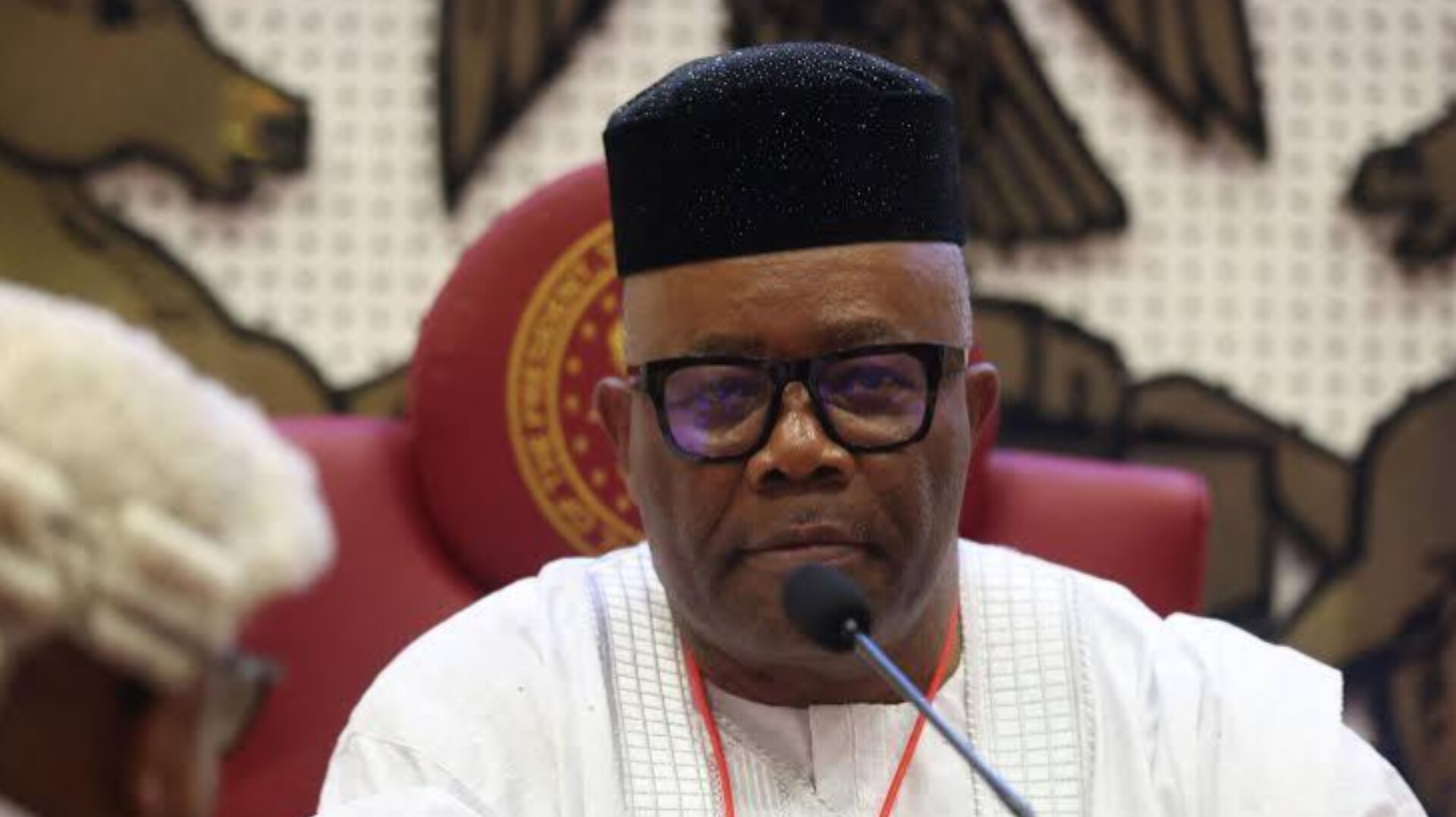
 Godswill Akpabio


Parliaments are remembered by the signature Bills that they passed. For the Godswill Akpabio-led 10th National Assembly, one of such Bills is the Electoral Act 2022 (Amendment) Bill 2026, which took it about two years to process.
Both the making of the Bill and the eventual Presidential assent attracted so much attention because of the potential implications of the Bill on our politics and governance system.
With President Bola Ahmed Tinubu signing the Bill into law, on Wednesday 18th February, 2026, Nigeria’s electoral system is now being governed by the Electoral Act 2026.

Some people wished that the President had declined assent to the Bill. But in an indication that he had followed the process of the Bill, the President affirmed it with his assent within 24 hours of its passage.
Lest we forget, this is the fourth time Nigeria has reformed its electoral law in the Fourth Republic.
The first occasion was during the Olusegun Obasanjo presidency in 2002. The Electoral Act 2002 that emerged governed the 2003 and 2007 election cycles.
The second exercise, undertaken during President Goodluck Jonathan’s administration, produced the Electoral Act 2010, which was used for the 2011 and 2015 polls.
What would have been the third electoral reforms exercise ended as a fiasco in the build up to the 2019 polls. On 13th December, 2018, President Muhammadu Buhari returned to the sender the Electoral Act 2015 (Amendment) Bill 2018, after the National Assembly forwarded it to him for assent.
It was the fourth time that Buhari declined assent to the Bill within 12 months. His reasons, as communicated to the National Assembly, were drafting errors and the Bill being too close to the 2019 General Election.
When the National Assembly again amended the Electoral Act before the 2023 polls, Buhari initially withheld assent again. However, after some back and forth, he eventually signed the Electoral Act 2010 (Amendment) Bill 2022 into law.
So it is a huge achievement for the Akpabio-led Assembly that the 2026 amendment Bill received Presidential assent in record time.

As with the Electoral Act 2022, the main criticism of the Electoral Act 2026 surrounds the mode of transmission of election results.
In the Electoral Act 2022, transmission mode was left to INEC to determine, and that drew the anger of the opposition and civil society groups. The difference in this Electoral Act 2026 is that electronic transmission of results has become mandatory. So why are some people still angry with the law?
Two reasons. First, it did not expressly state that transmission must be done in “real time. Second, it allows manual transmission as a backup, in the event that a “communication failure” obstructs electronic transmission.
For the critics, as the Senate President put it, it is electronic transmission or no results. Democracy enables the minority to have their say. But it also enables the majority to always have their way.
The new electoral law has 154 clauses. But the vocal “all or nothing” critics want the law jettisoned because of Clause 60(3). As a reminder, that clause, for the first time ever, compels INEC to transmit poll results electronically, as they advocated for. Their anger is that it also provides for manual documentation of results as a backup, where or when electronic transmission fails.
Most of the critics of the new law appear not to be familiar with its details. For instance, they seem to be unaware of the safeguard provided in Section 60(6), which slam six months jail term or N500,000 fine or both on any Presiding Officer who frustrates electronic transmission of poll results.
Consider, also, its provisions to strengthen internal democracy in the Political Parties, where selection of candidates is always a big issue and was one of the reasons that Buhari declined assent to the Electoral Act 2010 (Amendment) Bill 2022. The Ninth National had proposed in the Bill that parties shall nominate their candidates for elections by consensus or through direct primaries. But Buhari disagreed with the lawmakers who apparently wanted to strip the State Governors of their power of influence in the the process as their appointees are also delegates for indirect party primaries. He insisted on the retention of Indirect Primaries as an option before assenting to the Bill.
But in the Electoral Act 2026, the candidate nominations shall now be by consensus or Direct Primaries.
The new law also prescribes a 10 years jail term for electoral offences like falsification of election results.
Section 3 also establishes a dedicated fund to guarantee INEC financial independence. There are many other salient issues addressed by the law, which deserve the attention of Nigerians, including the critics and professional protesters, and for which the document should be supported. After all, there is no end to reforms, as no law is perfect.
On the Electoral Act 2026, the Akpabio-led 10th Assembly has done its bit and left judgment and the rest to posterity.
***Awoniyi, Media Aide to Senate President, writes from Abuja