
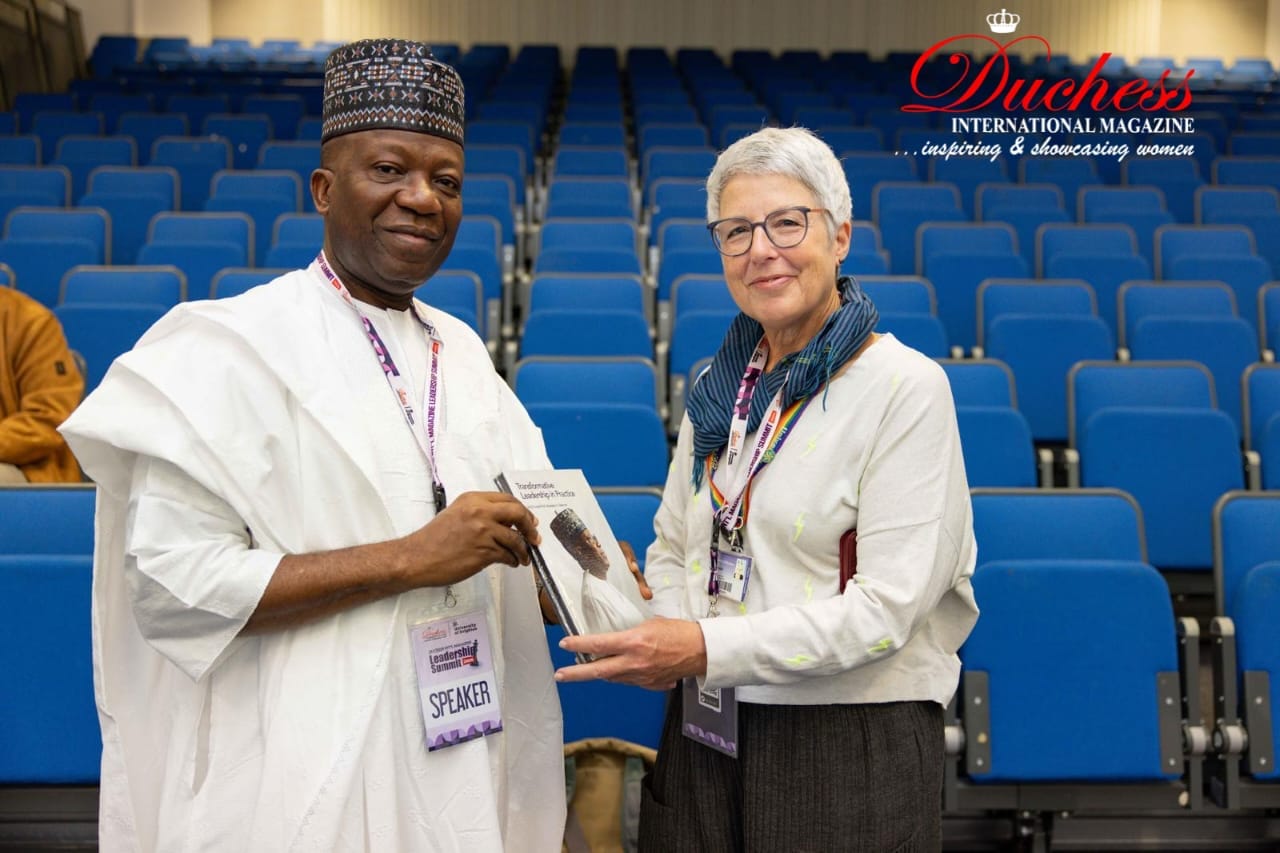


History, Professor Abubakar Olanrewaju Sulaiman believes, has little memory for those who merely held office. It remembers those who left their institutions stronger than they found them.
That was the message the Director-General of Nigeria’s National Institute for Legislative and Democratic Studies (NILDS) carried to the International Leadership Summit at the University of Brighton on 16 October 2026.
Standing before an international gathering of leaders, thinkers and changemakers, he delivered a keynote titled “Leadership in Practice: Making Decisions, Managing People and Delivering Results.”
Drawing on more than three decades in academia and public service, he challenged the assumption that leadership belongs to those at the top.
“Leadership is not the privilege of those who occupy high office; it is the discipline of those who accept responsibility for changing the trajectory of institutions and improving the lives of people,” he said. “Titles confer authority, but only character, competence and vision confer leadership.”
From there, Sulaiman built his case on three pillars: making sound decisions, managing people with differing expectations, and delivering measurable results.
Today’s institutions, he argued, need leaders who can navigate uncertainty, nurture human potential and turn vision into public value.
Good intentions, in his view, are not enough. “Vision without execution is fantasy. Decisions without outcomes are intentions. Managing people without results is merely activity,” he said.
To show what this looks like in practice, he turned to the institute he leads.
Under his tenure, he said, NILDS has grown from four operational departments to thirteen professionalised ones. It has added new institutional centres, launched Democracy Radio, and strengthened its research, legislative drafting, academic and capacity-building work.
The institute’s move into its permanent complex on 25 May 2023, after years of delay, was a turning point, he said.
“That relocation was much more than a physical movement. It represented institutional stability, growth, identity and a long-term vision for democratic capacity-building.”
The results, he said, can be counted. Annual training programmes have climbed from about 13 to about 60, an increase of more than 360 per cent.
Over the past seven years, NILDS has delivered more than 200 capacity-building programmes and trained over 3,000 legislators, parliamentary staff and public officials. It has also built more than 20 strategic partnerships.
Legislative capacity, he added, has been strengthened across Nigeria’s 36 State Houses of Assembly.
Behind those figures, Sulaiman insisted, is a conviction about people.
“If decision-making is the heart of leadership, managing people is its soul. No leader achieves anything alone,” he said.
He described an institute that invests in staff welfare, professional development and career progression. It shares decision-making instead of concentrating it, he said, because teams do better when they are empowered.
That commitment extends to the next generation. NILDS offers internships to young lawyers in legislative drafting and engages more than 60 National Youth Service Corps members every year.
The institute has also widened its engagements across Africa and backed initiatives for women’s political leadership.
Sulaiman said this trajectory is positioning NILDS as an emerging African democratic knowledge hub, where legislative research, executive education, parliamentary diplomacy and democratic innovation meet.
He closed with what he called the Leadership Covenant, a challenge to leaders everywhere.
Anchor decisions in purpose rather than popularity, he urged. Value people before processes. Judge success by the strength of the institutions left behind.
Living by that covenant, he said, takes the courage “to confront what is difficult rather than simply manage what is convenient,” even under unfavourable circumstances.
“History rarely remembers those who merely occupied office,” he said. “It remembers those who expanded the possibilities of institutions, elevated the dignity of people and left society more capable than they found it.”
His final words were a call to a generation.
“That, to me, is the essence of leadership in practice. It is the leadership Africa deserves. It is the leadership democratic institutions require. And it is the leadership this generation must be prepared to bequeath to the next.”