
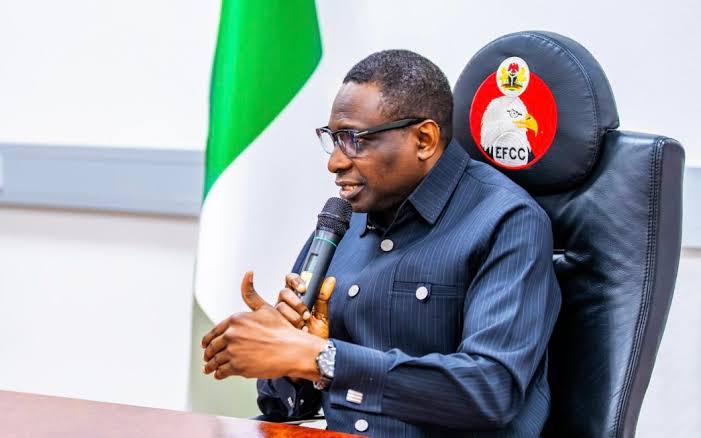

The Chairman of the Economic and Financial Crimes Commission, Ola Olukoyede, has alleged massive diversion of public funds allocated for Christian and Muslim pilgrimages, saying investigations uncovered disturbing financial practices within some pilgrimage agencies.
Olukoyede said as much as 75 per cent of government funds released for pilgrimage programmes was allegedly stolen by officials entrusted with managing the money.
The EFCC chairman disclosed this in Abuja while speaking at a meeting of the Nigeria Inter-Religious Council and the presentation of the commission’s Interfaith Manual to religious bodies.
According to him, the commission made the discoveries during investigations into the activities of the Christian and Muslim pilgrimage boards.
He said the findings were “mind-boggling”, alleging that some officials established private companies in countries where Nigerian pilgrims travelled and used the arrangements to create conflicts of interest.
Olukoyede said the alleged diversion of pilgrimage funds highlighted a wider problem of weak financial accountability within some religious institutions and government-backed faith programmes.
He challenged religious leaders to begin the fight against corruption by putting their own financial affairs in order.
The EFCC boss warned pastors, imams and other religious leaders against mixing funds belonging to their organisations with personal income or business interests.
He said offerings, tithes, zakat and other funds received by religious organisations should remain separate from the personal finances of their leaders.
“When money is paid to your organisation, don’t divert it to your business. That is criminal,” Olukoyede said.
He urged religious organisations to develop clear financial compliance procedures to distinguish between institutional funds and personal resources.
According to him, money entrusted to religious leaders belongs to the organisation and its members and must be managed in accordance with its purpose.
Olukoyede also took aim at the practice of accepting questionable donations from wealthy individuals, particularly public officials whose known earnings may not appear consistent with their wealth.
He asked religious leaders to question the source of unusually large donations rather than automatically accepting and blessing them.
The EFCC chairman said a religious leader who knowingly accepts money suspected to be proceeds of crime risks providing moral cover for corruption.
He further called on faith leaders to make integrity and anti-corruption values central to their preaching, arguing that religious institutions have an important role in shaping public attitudes towards illicit wealth.
Olukoyede said corruption should not be protected by religion, ethnicity or political affiliation.
He maintained that no religious community should shield an alleged offender because of his or her faith, just as no ethnic or political group should treat investigations into alleged wrongdoing as an attack on the group.
The EFCC chairman also warned that charitable donations should not be used to give legitimacy to wealth allegedly acquired through the suffering or deprivation of others.
He said Nigeria needed a new social compact in which legitimate wealth is respected while illicit wealth loses its prestige in places of worship.
The EFCC’s presentation of the Interfaith Manual formed part of efforts to deepen collaboration with religious institutions in promoting ethical conduct, accountability and the fight against corruption.