
‘We Now Have a Future’: Kogi Graduates Hail Dangote’s Fish-Farming Training
beneficiaries embrace new livelihoods, vow to build thriving businesses

By Friday Idachaba, Lokoja
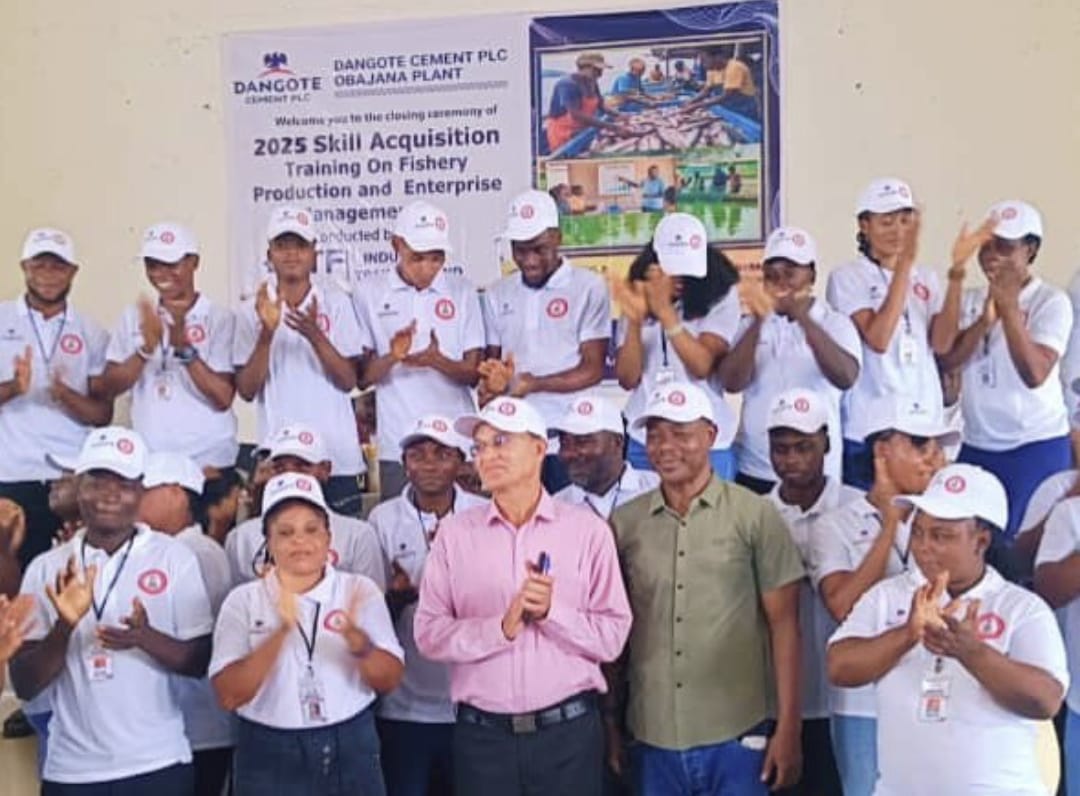
For over 40 residents of Obajana and surrounding communities in Kogi State, a new chapter has begun—one defined not by uncertainty, but by opportunity, skill, and hope.
Freshly graduated from a fish-farming and entrepreneurship training programme sponsored by Dangote Cement Plc, the beneficiaries say they are now equipped to take control of their economic future.
Many of them—mostly women from Iwaa, Oyo, Obajana, and Apata—described the training as life-changing, opening their eyes to practical ways of earning income and supporting their families.
“We came here not knowing much, but today we are leaving with skills that can feed our homes and even employ others,” one of the graduates said, reflecting the shared optimism among participants.
Beyond technical knowledge, the trainees said the programme instilled discipline, patience, and the confidence to start small but think big.
At the graduation ceremony, the Plant Director, Azad Nawabuddin, reaffirmed the company’s commitment to community development, noting that empowering individuals ultimately strengthens the wider society.
But for the graduates, the impact is already deeply personal.
“With what we’ve learned, we don’t have to wait for jobs anymore—we can create our own,” another beneficiary said.
To ease their transition into business, participants were provided with starter packs, including juvenile fish and feed, a gesture many described as the critical push needed to begin immediately.
The support, facilitated in partnership with the Industrial Training Fund, ensures that the training does not end in theory but translates into real economic activity.
Some beneficiaries are already making plans to scale their operations, form cooperatives, and explore local markets for fish supply.
“We want to grow beyond just feeding our families. We want to supply our communities and even beyond,” a participant added.
Community leaders also see the programme as a turning point. The Bajana of Obajana, HRH Idowu Isenibi, urged the graduates to pass on their knowledge, while the Elesho of Iwaa, HRH Abel Alade, expressed confidence that the initiative would ripple across generations.
For many, the training represents more than skills acquisition—it is a pathway to dignity, independence, and resilience.
As one graduate simply put it: “We now have something of our own. And that changes everything.”