
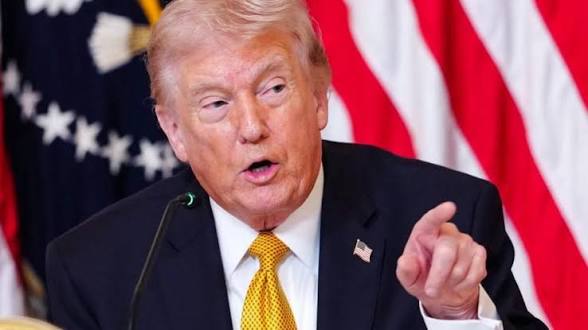

U.S. President Donald Trump has indicated a possible wind-down of military operations against Iran, even as Washington moves to ease oil sanctions in a bid to stabilise volatile global energy markets.
In a message posted on Truth Social, Trump said the United States was “getting very close” to achieving its objectives in the Middle East, hinting at a gradual scaling back of hostilities after weeks of sustained military pressure.
The remarks come amid intensifying regional tensions, with Iran launching renewed drone and missile attacks on Saudi Arabia and Israel. The strikes followed claims by Iran’s Supreme Leader, Mojtaba Khamenei, that Tehran had delivered a “dizzying blow” to its adversaries.
Despite Trump’s suggestion of a drawdown, the White House insists the campaign remains on course.
Press Secretary Karoline Leavitt said the operation, initially projected to last four to six weeks, is progressing ahead of schedule, with Iran’s military capabilities “significantly weakened.”
Oil Politics and Global Pressure
In a parallel move, the U.S. Treasury has temporarily relaxed restrictions on Iranian oil shipments already at sea, unlocking an estimated 140 million barrels into the global market through mid-April.
Treasury Secretary Scott Bessent said the decision aims to cushion the shock from tightening supply lines, as crude prices surge amid escalating conflict.
The disruption is largely tied to Iran’s effective blockade of the Strait of Hormuz—a critical artery through which roughly 20 per cent of global oil and gas flows. The move has rattled markets, pushing Brent crude above $112 per barrel.
The conflict continues to reverberate across the Middle East. Fresh explosions rocked Tehran, while Israel accused Iran of targeting religious landmarks in Jerusalem, including the Al-Aqsa Mosque compound and surrounding holy sites.
Missile and drone attacks have also struck key energy facilities in Kuwait and Qatar, further heightening fears of a broader regional conflagration.
In response, Israeli forces launched strikes on positions linked to Hezbollah in Lebanon, prompting evacuation warnings in affected areas. Meanwhile, Turkey has condemned Israeli attacks on Syrian military installations as a “dangerous escalation,” underscoring growing international unease.
Despite signalling a possible drawdown, Trump dismissed calls for a ceasefire, declaring the United States is in a position of strength.
“We have won,” he told reporters at the White House. “You don’t do a ceasefire when you’re obliterating the other side.”
He also criticised NATO allies for what he described as reluctance to take greater responsibility in securing the Strait of Hormuz, arguing that nations reliant on the route should shoulder more of the burden.
While ruling out the deployment of ground troops, reports suggest additional U.S. Marines are being repositioned to the region, signalling that Washington is not yet ready to fully disengage.
With Iran’s leadership structure in flux and diplomatic channels largely frozen, prospects for immediate de-escalation remain uncertain—even as Washington balances military momentum with mounting global economic pressure.