
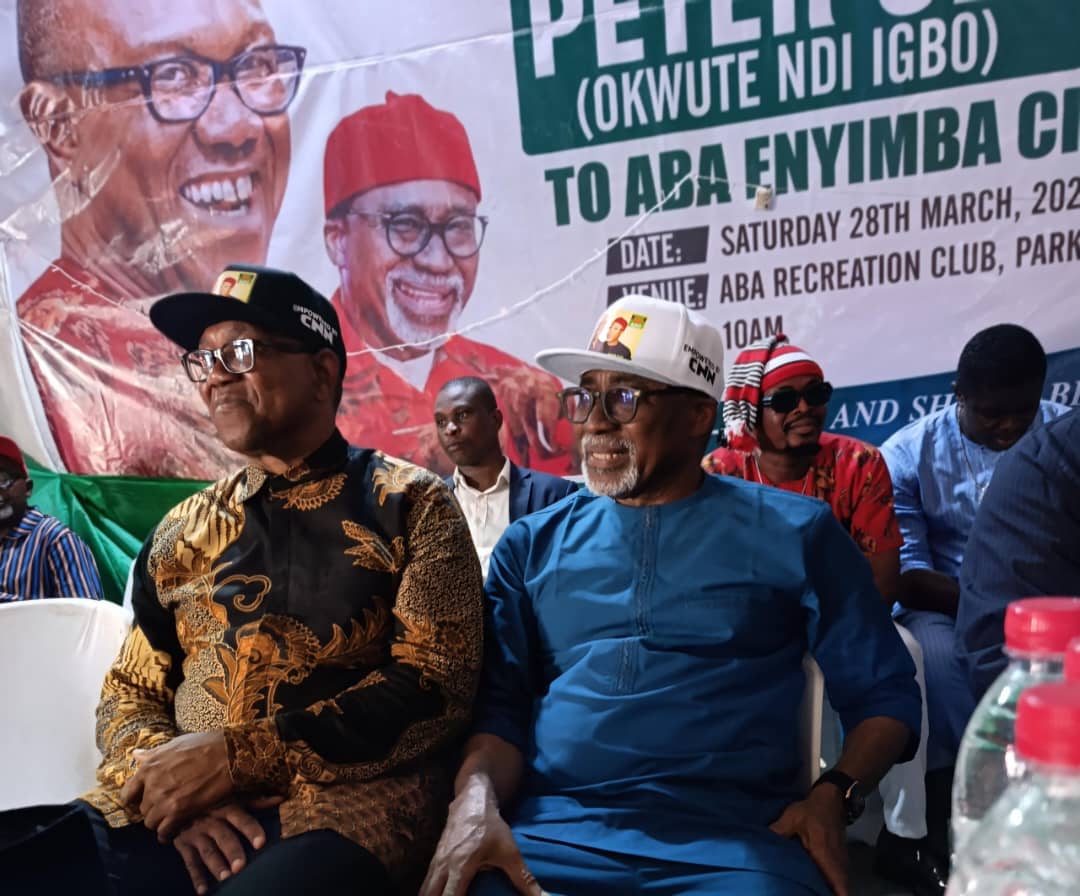

Former presidential candidate of the Labour Party(LP) in the 2023 general election, Peter Obi, has renewed his call for Nigeria to transition from a consumption-based economy to a production-driven model, insisting that cities like Aba in Abia State can play a central role in transforming the nation’s economic fortunes.
Obi made the remarks on Saturday, March 28, during a visit to Aba where he engaged with political stakeholders of the Africa Democratic Congress (ADC).
Writing on his X-Hqndle he indicated that the visit came at the invitation of Senator Enyinnaya Abaribe, who hosted the gathering that brought together party leaders and stakeholders for discussions on national development and political collaboration.
Describing the reception as warm and engaging, Obi expressed appreciation to Senator Abaribe and his team for the invitation, noting that such platforms are essential for constructive dialogue on the future of the country. He also commended the efforts of Governor Alex Otti, praising what he described as visible improvements in governance and infrastructure in Aba, widely known as Enyimba City.
During the visit, Obi also featured in a one-hour interview with Magic FM, marking his first media engagement of the year on both radio and television. In the interview, he expanded on his long-standing economic philosophy centered on production, productivity, and value creation.
According to Obi, Aba remains one of Nigeria’s strongest industrial hubs, particularly in garment and footwear manufacturing. He argued that with adequate support, infrastructure, and policy backing, the city could become a major contributor to Nigeria’s non-oil export economy.
Drawing comparisons with global economies, Obi highlighted how countries such as Bangladesh and Vietnam have successfully leveraged their textile and footwear industries to generate significant national revenue. He noted that garments and shoes contribute substantially to these countries’ economies—sometimes generating income comparable to or even exceeding Nigeria’s oil revenues—and said Nigeria could achieve similar results if it prioritizes and properly manages its industrial base.
Obi stressed that Nigeria’s challenge is not a lack of resources or talent, but a deficit in leadership quality. He emphasized the need for leaders who possess competence, compassion, and a genuine commitment to national development. According to him, these attributes are critical for designing and implementing policies that will drive sustainable growth and lift millions of Nigerians out of poverty.
He reiterated that the path to economic recovery lies in empowering local industries, supporting small and medium-scale enterprises, and creating an enabling environment for manufacturing to thrive. By shifting focus from consumption to production, Obi argued, Nigeria can build a resilient economy capable of competing globally.
The former Anambra State governor also underscored the importance of decentralizing economic opportunities across regions, noting that cities like Aba can serve as engines of growth if given the necessary support and attention. He called for deliberate investments in infrastructure, access to credit, and policies that encourage entrepreneurship and industrialization.
Obi’s visit and remarks come amid ongoing national conversations about economic diversification and the urgent need to reduce Nigeria’s dependence on oil revenue. His consistent advocacy for production-driven policies continues to resonate with many Nigerians seeking sustainable solutions to the country’s economic challenges.
Concluding his remarks, Obi reaffirmed his optimism about the future of the country, stating that with the right leadership and collective effort, Nigeria can achieve its full potential.
“A New Nigeria Is Possible,” he declared, signaling his continued belief in a nation built on productivity, innovation, and accountable leadership.