
 Professor Demo Kalla and Idris Ajimobi
From Science to Policy: Nigeria’s Strategic Leap in Livestock Innovation, Execution
***A Defining Moment for Nigeria’s Livestock Future

Nigeria’s livestock sector—long a cornerstone of rural livelihoods and a largely untapped economic engine, is entering a decisive new chapter. What is unfolding is more than policy reform; it is a convergence of science, governance, and industry anchored on one central reality: the country already has the knowledge and tools to transform livestock production—what remains is the discipline to execute.
This momentum was unmistakable at the Second Biennial Conference of the Society for Animal Reproduction and Improvement (SARI), themed “Sustainable Animal Reproduction for Food Security.”
The gathering moved beyond theoretical dialogue into a space defined by urgency, clarity, and shared purpose.
At the centre of this alignment were Professor Demo Kalla, a leading authority in animal reproduction science, and Idris Ajimobi, Senior Special Assistant to the President on Livestock Development. Together, they delivered a unified message: innovation must be matched with deliberate, sustained execution if Nigeria is to unlock the full potential of its livestock sector.
Professor Kalla’s keynote set a decisive tone for the conference. His message was clear and direct: Nigeria’s challenge is no longer a lack of ideas, but a failure to implement them effectively.
“Policies alone do not transform sectors—implementation does,” he declared, warning that without deliberate action, even the most well-crafted policies will fall short of their intended impact.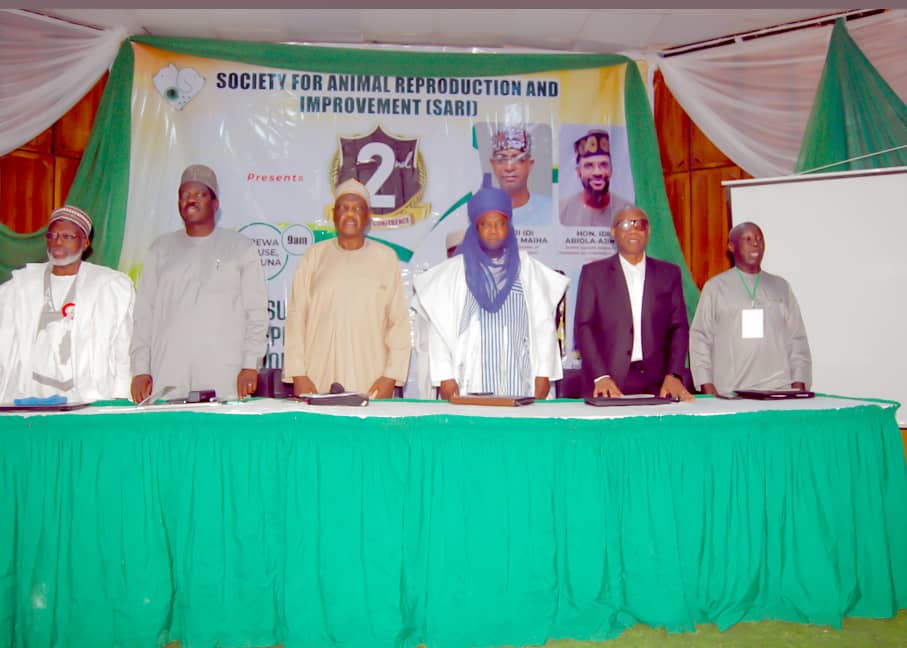
In his presentation, “Biology Meets Innovation—Advancing Animal Reproduction for Sustainable Food Security in Nigeria,” Kalla positioned science as the engine of transformation.
He highlighted Assisted Reproductive Technologies (ART) as critical tools capable of redefining livestock productivity and genetic advancement.
These include widely used techniques such as artificial insemination and embryo transfer, as well as more advanced innovations like ovum pick-up (OPU), in vitro fertilisation (IVF), and intracytoplasmic sperm injection (ICSI).
Together, they are reshaping how livestock is bred, improved, and scaled.
“These technologies are not just scientific advancements; they are practical solutions to Nigeria’s food security challenges,” he stressed.
Kalla further spotlighted emerging breakthroughs such as CRISPR-Cas9 gene editing, semen sexing, and fixed-time artificial insemination (FTAI), describing them as powerful tools for producing resilient, disease-resistant, and high-yield livestock.
Yet his vision extended beyond biology.
He underscored the role of digital agriculture—artificial intelligence, biosensors, and data analytics—as essential tools for modern livestock management.
These technologies, he argued, are critical for improving monitoring systems, enhancing decision-making, and increasing efficiency across the value chain.
At Abubakar Tafawa Balewa University (ATBU), where he leads research into climate-smart livestock systems, Kalla is driving a shift toward a structured, data-driven livestock economy.
“Nigeria must begin to see livestock as a business, not just a way of life,” he said, calling for structured breeding systems, improved feed systems, and modern dairy practices aligned with global standards.
Buttressing this scientific vision, Idris Ajimobi provided a strong affirmation of the Federal Government’s commitment to livestock transformation under President Bola Ahmed Tinubu.
He described the conference theme as both timely and critical, noting that animal reproduction and genetic improvement are central to building a climate-resilient and productive livestock system.
“As we confront challenges such as low productivity, climate variability and increasing demand for animal protein, it is imperative that we leverage science, innovation, and collaboration,” he stated.
Ajimobi assured stakeholders that the government remains committed to policies and programmes designed to increase livestock productivity, strengthen food systems, and improve livelihoods across Nigeria.
He also recognised SARI as a vital bridge between research and policy, emphasising that collaboration between government and scientific institutions is essential to translate knowledge into real-world outcomes.
While policy provides direction, institutions like SARI are driving implementation and impact.
Professor S. Idowu Ola, President of SARI, made this distinction clear, emphasising that the organisation was created not as a symbolic association, but as a solution-driven platform focused on measurable outcomes.
“SARI was designed to be impactful, not symbolic,” he stated. “Our goal is to drive real change in animal reproduction and improvement in Nigeria.”
Since its establishment at the University of Ibadan in February 2022, SARI has positioned itself as a collaborative hub, bringing together scientists, theriogenologists, and industry stakeholders to tackle real challenges within the livestock sector.
The organisation also prioritises inclusivity, integrating both professional and associate members to ensure a wide pool of knowledge and expertise.
Professor Ola highlighted SARI’s strengthening collaboration with the Federal Ministry of Livestock Development under Alhaji Idi Mukhtar Maiha, noting that such partnerships are critical for aligning research with policy execution.
SARI’s impact extends far beyond conferences. Through its monthly Reprotalk webinar series, launched in July 2025, the organisation has created a continuous platform for dialogue, innovation, and knowledge exchange.
“These webinars are not just discussions—they produce actionable insights that guide interventions,” Professor Ola explained.
SARI is also contributing to national policy development, including its participation in the National Advisory Committee on Animal Genetic Resources in June 2025.
These engagements ensure that scientific expertise directly informs national strategies.
On the global stage, the organisation has established partnerships with bodies such as the International Congress on Animal Reproduction, positioning Nigeria within the framework of global best practices.
Domestically, SARI is working with key industry players, including the Red Boer and Kalahari Goat Breeder Association of Nigeria, to improve breeding systems and strengthen livestock quality nationwide.
As discussions progressed, the Federal Government reinforced its commitment to turning vision into action.
Minister of Livestock Development, Alhaji Idi Mukhtar Maiha, delivered a firm closing address that echoed the central message of the conference: execution determines success.
He called for stronger collaboration across all levels of the sector, urging stakeholders to support pilot projects, strengthen monitoring and evaluation systems, and ensure accountability in all interventions.
“We must engage all stakeholders to achieve comprehensive outcomes and sustainable progress in the livestock sector,” he said.
Maiha also stressed the importance of aligning Nigeria’s livestock systems with global veterinary standards to ensure quality, consistency, and efficiency across the entire value chain.
A key component of Nigeria’s livestock transformation agenda is the National Animal Identification and Traceability System.
Kalla described it as a critical tool for disease control, food safety, and market expansion.
However, he emphasised that its effectiveness depends on full nationwide adoption and strict enforcement. Without this, even the most advanced systems risk underperforming.
Institutions such as the Standards Organisation of Nigeria and the Nigerian Institute of Animal Science were also highlighted as essential regulatory bodies responsible for maintaining quality and enforcing compliance across the sector.
Looking ahead, Kalla underscored the need to actively engage Nigeria’s youth in the livestock economy. He pointed to initiatives under the National Centre for Artificial Intelligence and Robotics (NCAIR), where young innovators are already developing technology-driven solutions for agriculture.
“We must empower young people to see opportunities in livestock—not just in farming, but in technology, logistics and agribusiness services,” he said.
This vision signals a broader shift—one that positions livestock as a modern, technology-enabled industry driven by innovation, entrepreneurship, and digital transformation.
As Nigeria grapples with population growth and rising demand for animal protein, the stakes could not be higher. Yet, for the first time in years, there is a clear alignment between scientific insight and government policy.
The message emerging from the conference is unmistakable: Nigeria already has the science, the policy frameworks, and the institutional partnerships needed to transform its livestock sector.
What remains is execution.
Kalla captured the essence of this moment in a powerful closing line:
“The future of our food system depends on what we do with livestock today.”
As the conference concluded, optimism filled the room—but so did urgency. The path forward is clear, the tools are available, and the institutions are aligned.
Now, the responsibility lies with Nigeria to act decisively and turn promise into progress.