
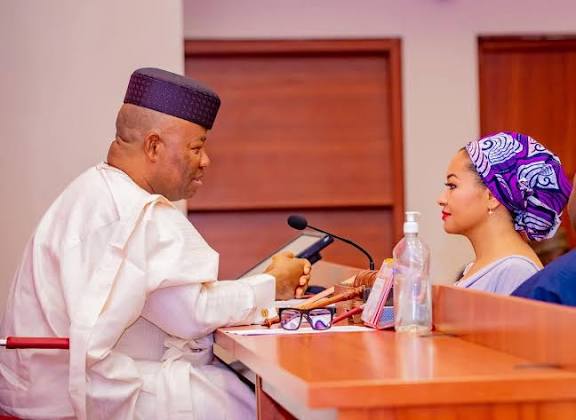
 Godswill Akpabio and Natasha Akpoti-Uduaghan

Senate President Godswill Akpabio has reversed his earlier position in his dispute with Kogi Central senator, Natasha Akpoti-Uduaghan, by approaching the Supreme Court over her suspension from the Senate.
Earlier in January, the Akwa Ibom lawmaker announced the withdrawal of all defamation suits he had filed against Akpoti-Uduaghan, saying the decision followed a sermon he listened to during a New Year Mass. Speaking at Sacred Heart Parish in Uyo, Akpabio disclosed that he had instituted nearly nine defamation cases against individuals he accused of lying and slandering him, but decided to discontinue them after reflecting on the priest’s message.
Akpoti-Uduaghan had accused the Senate President of sexual harassment, an allegation that culminated in her suspension and a series of court actions. Akpabio had publicly stated that he had withdrawn the related cases.
However, documents obtained by journalists on Thursday revealed that Akpabio has now filed processes at the apex court, seeking to regularise and pursue an appeal against decisions of the lower courts on the matter. The case is marked SC/CV/1111/2025, arising from CA/ABJ/CV/1107/2025 and FHC/ABJ/CS/384/2025.
In the suit, Akpabio is listed as the appellant, while Akpoti-Uduaghan, the Clerk of the National Assembly, the Senate of the Federal Republic of Nigeria, and the Chairman of the Senate Committee on Ethics, Privileges and Public Petitions, Senator Neda Imasuen, are named as respondents.
The Federal High Court in Abuja had, on July 4, 2025, declared Akpoti-Uduaghan’s suspension excessive and unconstitutional. Although subsequent proceedings at the Court of Appeal led to the striking out of some motions, the appellate court ordered Akpabio to pay a N100,000 fine to the Kogi senator.
Before the Supreme Court, Akpabio is seeking an extension of time to apply for leave to appeal on grounds of mixed law and fact, as well as orders deeming his notice of appeal and brief of argument as properly filed. He argues that the Senate acted within its powers under Section 60 of the 1999 Constitution, which empowers the National Assembly to regulate its internal affairs, and insists that the Senate President was not required to immediately rule on every point of privilege before activating disciplinary procedures.
Akpoti-Uduaghan, on her part, maintains that her suspension was unlawful and carried out without fair hearing, alleging that the Senate failed to follow its own rules. It was confirmed that her legal team has been served with the Supreme Court processes.
The dispute also includes a related contempt issue stemming from a social media post made by Akpoti-Uduaghan while the matter was pending in court. The Federal High Court had fined her and ordered a public apology, a ruling she has also appealed.
Legal analysts say the Supreme Court’s eventual decision could help define the boundaries between legislative discipline and judicial oversight. The move comes barely weeks after Akpabio publicly announced his decision to withdraw court cases against his adversaries.