
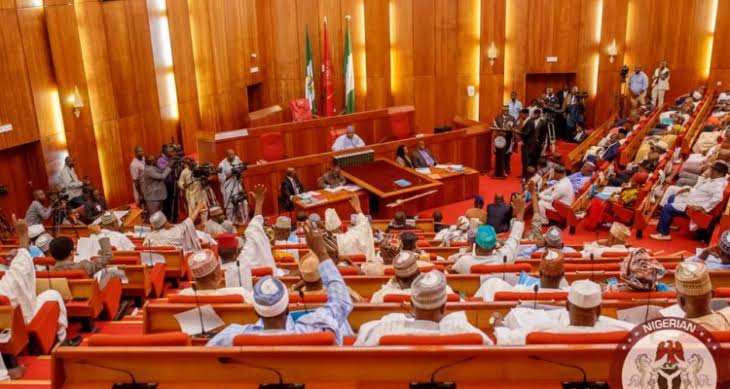

In one of the swiftest constitutional amendment exercises in recent legislative history, the Senate on Wednesday pushed through President Bola Tinubu’s State Police Bill in less than 24 hours, deploying a combination of political consensus-building, procedural flexibility and executive backing to secure passage of the landmark security reform.
The Constitution of the Federal Republic of Nigeria (Alteration) (State Police) Bill, 2026, which seeks to establish state police services across the federation, scaled First Reading, Second Reading, Committee of the Whole and Third Reading within a single legislative day.
The speed of its passage underscored the importance attached to the proposal by both the Presidency and the leadership of the National Assembly, amid growing concerns over the country’s worsening security challenges.
Investigations revealed that the accelerated consideration of the bill was made possible through the Senate’s reliance on provisions of its Standing Orders that permit the suspension or amendment of procedural rules where circumstances require.
A major turning point came during a closed-door executive session lasting nearly three hours, where senators deliberated on the implications of the proposal and were urged to view it as a national security imperative.
Sources familiar with the meeting said lawmakers were reminded of persistent calls for state policing and the mounting pressure on federal security agencies grappling with terrorism, banditry, kidnapping and other forms of violent crime across the country.
Although some reservations were expressed over aspects of the legislation, particularly federal oversight provisions, the overwhelming sentiment in the chamber favoured speedy passage.
Leading debate on the bill, Senate Leader Michael Opeyemi Bamidele described the proposal as one of the most consequential constitutional reforms since Nigeria’s return to democracy.
According to him, the legislation seeks to establish a constitutional framework for state police services while maintaining a strong federal policing structure capable of ensuring national standards, accountability and oversight.
Under the proposed amendment, states would be empowered to establish and operate their own police services after enacting enabling laws and meeting national standards prescribed by the National Assembly.
However, the Federal Government would retain substantial emergency powers.
The proposed new Section 214 authorises the Federal Police Service to intervene in any state where there is an actual or imminent breakdown of public order, a threat to national security, evidence of serious human rights abuses or where a state police service becomes incapable of effectively carrying out its duties.
The bill further empowers the Federal Police Service, subject to presidential approval, Senate oversight and judicial review, to temporarily assume operational control of a state police service where circumstances warrant such action.
To address fears that state police could become instruments of political intimidation, the legislation introduces safeguards prohibiting governors from directing police authorities against individuals, political parties, associations or groups.
It also bars the use of policing powers for partisan, ethnic, religious or sectional purposes.
The proposal establishes State Police Service Commissions to oversee recruitment, promotions and discipline, while a restructured National Police Council would coordinate policing policy nationwide.
Presiding over proceedings, Senate President Godswill Akpabio described the debate as one of the most significant responsibilities before the 10th Senate.
He urged lawmakers to approach the legislation with patriotism and foresight, stressing that history would judge the National Assembly by its willingness to confront difficult national challenges.
The high-level interest in the bill was reflected in the presence of key presidential aides, including Chief of Staff to the President and former Speaker of the House of Representatives, Femi Gbajabiamila.
His attendance was widely viewed as a signal of strong executive support for the proposal.
Proceedings were not without drama.
A brief procedural dispute emerged when Akpabio sought senators’ approval to admit the governors of Ondo, Ogun and Kaduna states into the chamber.
Some lawmakers initially objected on the grounds that Senate rules do not ordinarily permit governors to sit on the floor during plenary. Following consultations, however, the chamber approved their admission, citing their stake in the constitutional amendment process.
Another notable feature of the day’s proceedings was the voting method adopted by the Senate.
Rather than electronic voting, senators voted manually by rising to indicate support or opposition to specific clauses, making individual positions visible throughout deliberations.
By the end of the session, the Senate had approved a constitutional framework that seeks to balance state policing autonomy with federal oversight, setting the stage for what could become Nigeria’s most significant security sector reform in more than two decades.
The bill now awaits concurrence by the House of Representatives before proceeding to state Houses of Assembly for ratification.