

By: Lamara Garba
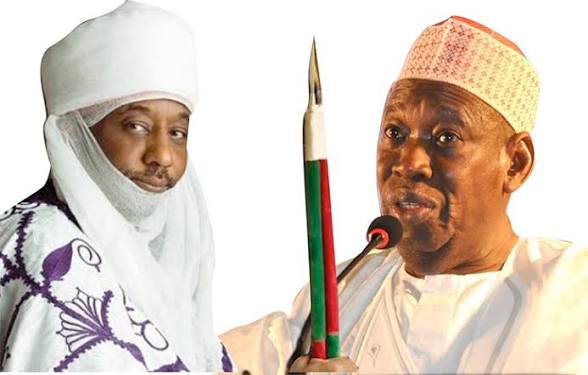
In Kano’s evolving political story, certain moments carry a quiet weight that goes beyond ceremony and routine. They do not announce themselves with noise, yet their meaning settles deeply in the public consciousness. The public acknowledgment of Muhammadu Sanusi II by Abdullahi Umar Ganduje as Emir of Kano and Chairman of the Kano State Council of Chiefs is one of such moments. It reflects a shift not only in posture but in perspective, where history, humility, and leadership meet to redefine the direction of a people.
For a state like Kano, where tradition and politics are inseparable threads in the fabric of society, this gesture carries unusual depth. It speaks to memory, to responsibility, and to the rare courage required to move beyond the past. Years ago, it was Ganduje who removed Sanusi from the throne in 2020, a decision that stirred intense reactions and left the state politically divided. That episode became one of the most defining and contentious moments in Kano’s recent history.

Yet time has a way of softening even the hardest edges.
Standing before a distinguished gathering at the Government House, Ganduje chose recognition over resistance. By addressing Sanusi with his full royal title, he did more than observe formal protocol. He embraced a new reality and, in doing so, sent a powerful message that Kano is ready to outgrow its divisions. The applause that followed was not merely for the act itself, but for what it symbolized. It was an affirmation that reconciliation, however delayed, remains possible.
At the heart of this unfolding transformation is Abba Kabir Yusuf, whose Kano First agenda is gradually assuming a deeper meaning. Beyond governance in its conventional sense, his approach reflects a commitment to healing political fractures and restoring collective purpose. Bringing together figures whose histories are marked by sharp differences is not an easy undertaking. It demands patience, persuasion, and a clear vision of what the state can become.
Uniting Ganduje and Emir Sanusi is therefore not just a political development. It is a moral statement. It suggests that leadership is not defined by past disagreements, but by the willingness to rise above them for the greater good.
In all of this, the conduct of Emir Sanusi stands out as a lesson in restraint and faith. Following his removal, he accepted the outcome without public hostility. He neither inflamed tensions nor sought to deepen divisions. Instead, he returned to a quiet life, guided by a firm belief that authority ultimately belongs to Allah, who grants and withdraws as He wills. Such composure in the face of power’s uncertainty reflects a philosophical depth that transcends politics.
There is strength in silence. There is dignity in patience.
Now, with his reinstatement and the open recognition of his authority, that patience finds expression in a restored balance rather than a personal victory. It is not a triumph of one individual over another, but a triumph of wisdom over discord. In this lies the beauty of the moment.
Kano today appears to be rediscovering itself. The coming together of its political and traditional leaders signals a readiness to chart a new course. It suggests that the state is beginning to understand that progress is best pursued in unity. Differences may remain, but they no longer have to define the future.
Governor Yusuf’s role in this process carries a certain quiet elegance. He is not merely administering policies; he is rebuilding relationships. Like a careful craftsman, he is mending what was once broken and aligning interests that once seemed irreconcilable. In doing so, he is creating an environment where governance can thrive without the burden of persistent conflict.
Development does not grow in the soil of division. It flourishes where there is trust, cooperation, and shared purpose. Kano, with its rich heritage and strategic importance, stands to gain immensely from this renewed spirit of unity.
There is something almost poetic in the unfolding reality. The past, once marked by tension, is gradually giving way to understanding. The voices that once stood apart are beginning to find a common rhythm. And within that rhythm lies strength, resilience, and hope.
This moment offers a lesson not just for Kano, but for the wider Nigerian landscape. It demonstrates that reconciliation is not weakness. It is wisdom. It shows that leadership is not about holding on to old battles, but about preparing the ground for future generations.
As Ganduje acknowledges Sanusi, and as Sanusi continues to embody patience and grace, and as Governor Yusuf steadily advances a vision rooted in unity, Kano writes a new chapter for itself. A chapter defined not by conflict, but by convergence. Not by rivalry, but by responsibility.
It is a chapter that reminds us that history can be revisited, not to reopen wounds, but to heal them.
It is a chapter that suggests that when leaders choose understanding over pride, the people will always benefit.
And in this unfolding story, Kano stands not just as a political center, but as a symbol of what becomes possible when unity is given a chance.
In that possibility lies the promise of a stronger, more peaceful, and more prosperous future for the state and its people.
Lamara Garba, a former Chairman of Kano NUJ Correspondents’ Chapel, writes from Kano