

By: Sanusi Bature Dawakin Tofa
A defining political moment unfolded in Lagos as loyalists of NNPP founder, Boniface Aniebonam, converged at his Apapa office in celebration of a decisive court victory that has reshaped the party’s leadership structure. The ruling of the Federal Capital Territory High Court in Abuja, which directed INEC to recognise the Agbo Major led National Working Committee, effectively nullified the claims of the faction aligned with Rabiu Musa Kwankwaso and the Kwankwasiyya Movement, setting the stage for what many now regard as a turning point in the NNPP’s internal power dynamics.
The celebration was not merely symbolic but deeply political. Songs, dancing and thanksgiving echoed through the venue, signaling what many within the camp see as the final collapse of the rival structure. In their view, the ruling has drawn a clear line under the prolonged leadership tussle, affirming ownership and restoring the party to its original custodians.

While the Kwankwasiyya faction has dismissed the judgment and signaled its intention to appeal, the optics of the Lagos celebration suggest a deeper reality. It portrays a movement that is steadily losing institutional footing. What was once projected as a dominant bloc within the NNPP now appears increasingly isolated and weakened by legal setbacks and internal contradictions.
Within this unfolding scenario, the earlier decision of Abba Kabir Yusuf to exit the NNPP now stands out as not just strategic but profoundly prophetic. At a time when many still believed the crisis could be contained, the governor had already read the signs of a looming structural breakdown. His defection to the All Progressives Congress was a calculated move to shield Kano from the instability that has now fully consumed the party.
Since the entrance of Rabiu Musa Kwankwaso into the NNPP in late 2022, the party has been embroiled in persistent internal wranglings. What should have been a smooth political expansion quickly degenerated into disputes, counter claims and a cycle of litigations across multiple courts. These legal battles not only fractured the party’s leadership but created an environment too volatile for any serious governance to thrive.
For a sitting government, such instability is more than a political inconvenience. It is a direct threat to focus, peace of mind and administrative efficiency. Governor Yusuf clearly understood that a state like Kano could not afford to be governed from within a party constantly entangled in courtrooms. Governance requires clarity, stability and direction, conditions that had become increasingly absent within the NNPP.
The events of today have validated that judgment. The celebrations by Aniebonam’s loyalists underscore the extent to which the party structure has shifted away from the Kwankwaso bloc. In stark terms, the former political stronghold has been reduced to a shadow of its past influence within the party.
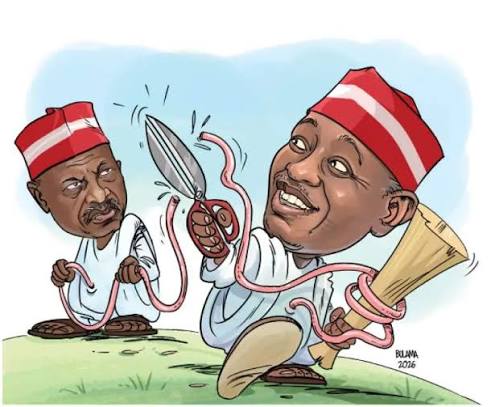
Indeed, a harsh but unavoidable metaphor now defines the situation. Rabiu Musa Kwankwaso appears politically like a wandering herdsman without shepherds, disconnected from a recognised structure and navigating an uncertain terrain without institutional backing. The court’s affirmation of a rival leadership has effectively placed him in a position where his relevance within the NNPP is severely diminished.
In practical terms, this leaves him perilously close to being politically homeless, a figure without a firmly recognised platform and with a future clouded by legal and structural dislocations. His refusal to align with Governor Yusuf in the strategic move to the APC now appears in hindsight as a significant political miscalculation, one that may carry lasting consequences for his political journey.
The contrast could not be clearer. While Kano under Abba Kabir Yusuf has secured stability within a broader national framework, the NNPP remains trapped in cycles of litigation and internal strife. The governor’s decision ensured that his administration would not be distracted by endless legal battles, thereby preserving the focus required to deliver democratic dividends to the teeming people of Kano.
In the final analysis, politics rewards those who can read the future before it arrives and act before circumstances impose their will. Power is never sustained by sentiment but by structure, clarity and timing. What is unfolding within the NNPP is a reminder that when a political house becomes divided against itself, its strongest voices can quickly fade into irrelevance. In contrast, leadership that prioritises stability over attachment secures not just survival but continuity. In this moment, the lesson is clear that history does not remember hesitation, it remembers decision.
Sanusi Bature Dawakin Tofa, is the Spokesperson to Gov. Abba Yusuf of Kano State