
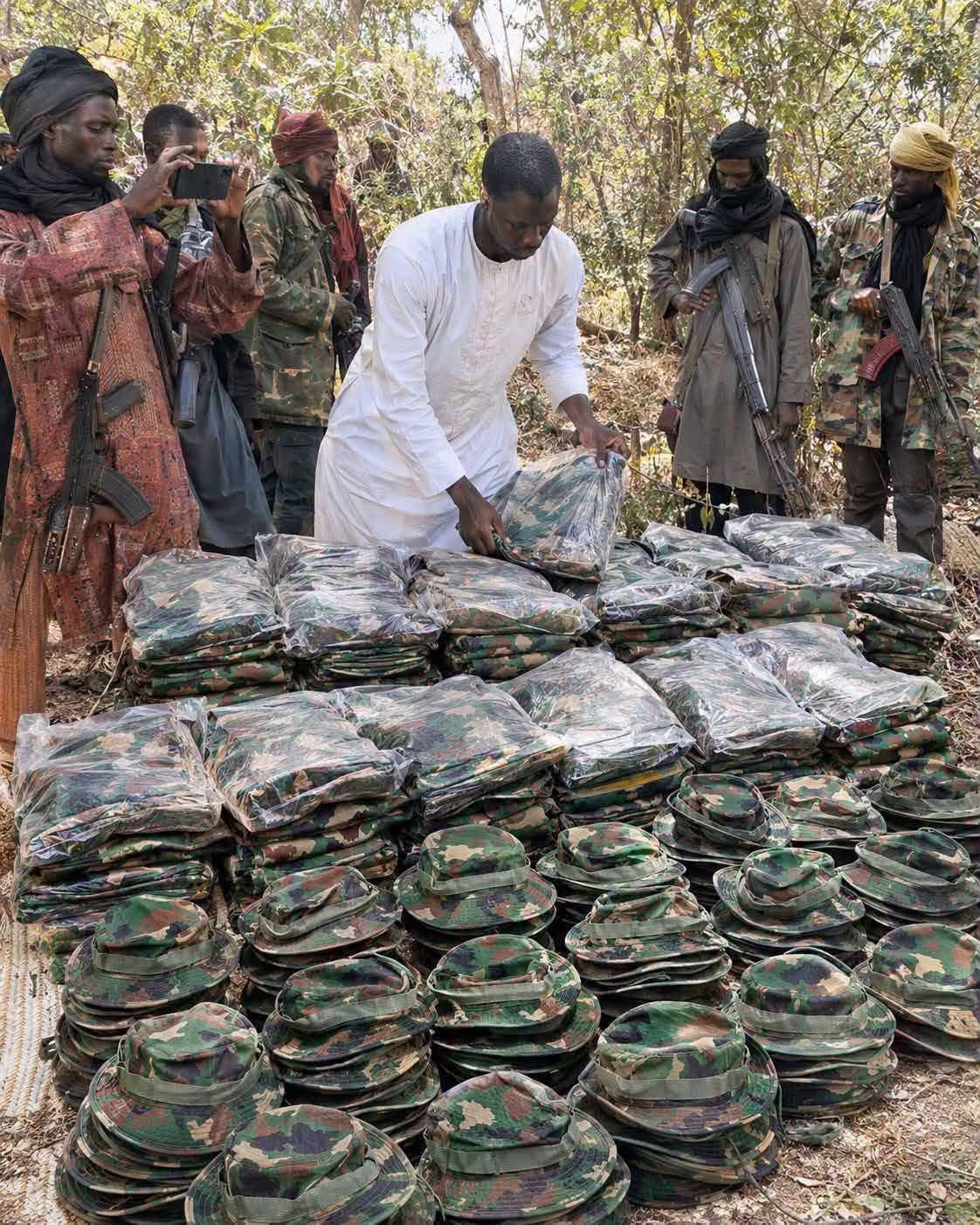


Former minister warns armed criminals could exploit military uniforms to impersonate troops, deceive villagers and mount fake checkpoints
Former Minister of Youth and Sports Development, Solomon Dalung, has questioned the effectiveness of Nigeria’s security monitoring system following the circulation of a photograph allegedly showing armed men sorting newly packaged military camouflage uniforms in a forest.
Dalung warned that the development, if verified, could expose a dangerous gap in the country’s security architecture, particularly the monitoring of military clothing, equipment and supplies.

He said the bigger concern was not merely that suspected bandits had access to camouflage uniforms, but how such materials could be manufactured, transported and delivered to armed groups operating outside the law.
Reacting to the photograph, the former minister said the military’s denial of involvement in the supply of the uniforms should not end the investigation.
He challenged security agencies to trace the entire supply chain and identify those who manufactured, sold, financed and transported the clothing to the forest.
Dalung argued that military camouflage in the hands of criminals could give them an opportunity to impersonate security personnel and exploit the trust Nigerians ordinarily place in people wearing official uniforms.
He warned that armed criminals dressed as soldiers could establish fake checkpoints, stop unsuspecting motorists, infiltrate communities and potentially carry out attacks under the appearance of legitimate security operations.

“Because a bandit in ordinary clothes is a criminal. But a bandit in camouflage is something else. He can mount a checkpoint and you will stop for him. He can walk into a village and people will think help has arrived,” he said.
The former minister also linked the controversy to broader questions about how armed criminal groups obtain weapons, intelligence and logistical support despite ongoing security operations.
He asked: “If they did not come from the military, then where did they come from? Who made them? Who sold them? Who carried them into the forest? Who paid for them?”
Dalung insisted that the country could not afford to treat the photograph as another fleeting social media controversy, warning that failure to investigate the source of the uniforms could leave Nigerians exposed to further security threats.
“Today it is uniforms. Tomorrow, what will it be? If we cannot trace how these uniforms ended up in the hands of armed men in a forest, how will we ever trace the guns?” he queried.
He called for an investigation capable of establishing the origin of the uniforms and determining whether individuals or commercial networks were supplying military-style clothing to criminal groups.
Dalung maintained that Nigerians deserved verifiable answers rather than official denials.
The photograph, however, has not been independently authenticated, and the identities of the men, the location where it was taken and the origin of the uniforms remain unclear.