
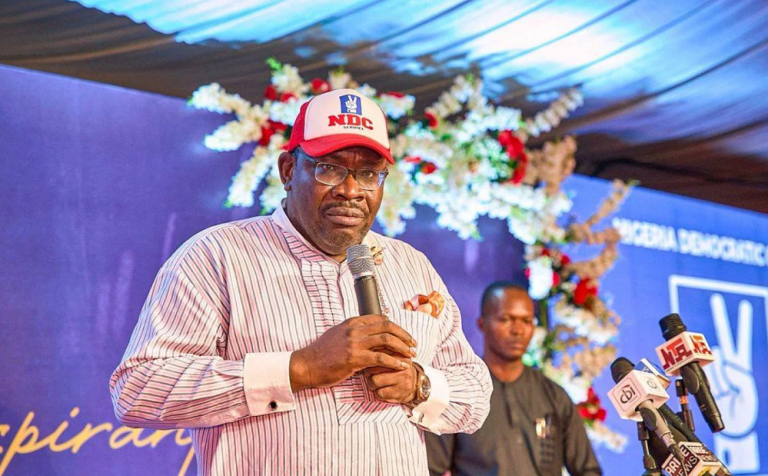

The National Leader of the Nigeria Democratic Congress (NDC), Senator Seriake Dickson, has drawn a clear line between the party’s official campaign machinery and support groups mobilising behind its 2027 presidential ticket.
Dickson said organisations supporting the NDC presidential candidate, Peter Obi, and his running mate, Rabiu Kwankwaso, have a role to play in grassroots mobilisation but cannot operate as parallel structures to the political party.
He spoke in Abuja while receiving former Secretary to the Government of the Federation, Babachir Lawal, into the NDC.
His comments came amid a dispute over a 59-member Presidential Campaign Council announced by the Obi-Kwankwaso Movement, popularly known as the OK Movement.
The NDC has dissociated itself from the council, saying it was not authorised by the party and should be disregarded.
Dickson said the distinction between political parties and support organisations was straightforward, arguing that support groups should complement the NDC rather than compete with the party over political space or authority.
“Support groups don’t compete with the political party that is sponsoring candidates. Support groups don’t compete for supremacy, for space,” he said.
According to him, support groups are expected to mobilise at the grassroots and promote the party’s candidates while working with the official campaign structure once constituted.
He also cautioned support organisations against attacking or presenting themselves as critics of the political party whose candidates they support.
Dickson said the NDC had mechanisms for coordinating support groups and remained open to working with organisations mobilising support for Obi and Kwankwaso.
He specifically questioned the decision by the OK Movement to establish what it described as a Presidential Campaign Council.
“None of them will dare say they are setting up a presidential campaign council. It’s unheard of. Nonsensical,” Dickson said, while urging those responsible for coordinating support groups to educate them on their roles.
The disagreement comes as the NDC prepares to inaugurate its official Presidential Campaign Council.
The party has said Obi and Kwankwaso would nominate key officers of the council in consultation with the NDC leadership. The positions are expected to include Director-General, Deputy Director-General (North), spokesman, deputy spokesman, Head of New Media and finance officials.
However, the OK Movement has maintained that it is an independent political organisation and not an appendage of the NDC.
Its Director-General, John Ughulu, said the movement had established structures at the national, state, local government and ward levels and would retain control of them.
Ughulu said the movement’s support for Obi and Kwankwaso did not amount to organisational subordination to the NDC.
He maintained that the OK Movement had the right to organise its members, coordinate volunteers and establish its own campaign and operational structures while supporting the NDC candidates.
The emerging disagreement has therefore placed the focus on the organisational boundary between the NDC’s formal party and campaign structures and independent organisations mobilising support for its 2027 candidates.