

By Douglas Baye-Osagie
_dbayeosagie@yahoo.com_
Great sportsmen leave behind a reputation. When the goals stop coming, when the trophies become memories and the boots are finally hung up, what remains is the story. For Victor Osimhen, that story may not be only about the goals he scored, the trophies he won, or the heights he reached. It may also be remembered for something more complicated — his constant charging into fights that don’t concern the ball. For a striker whose goal-scoring talent measures up to the very best in the world, he is meant to be a global star with a reputation that attracts brands.
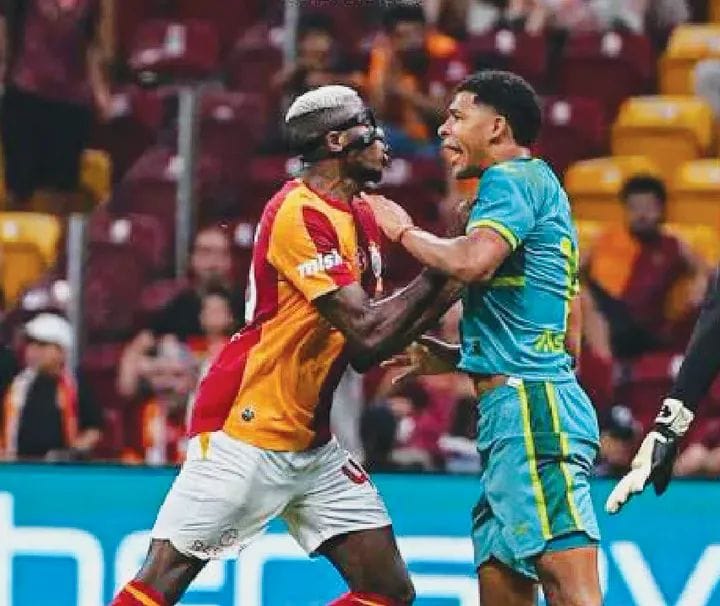
The recent round of controversial in-field outbursts has put Victor Osimhen right back in the spotlight, this time in a pre-season friendly. Villarreal’s coach Inigo Perez, didn’t mince words: _“There is not much to say about the football, because the opposing team didn’t come onto the field to play football, but to fight.”_ He was referring to Osimhen’s heated confrontation with Villarreal defender Santiago Mouriño at RAMS Park — an incident Perez described as an attack _“without any provocation.”_ It’s no longer about one tackle or one yellow card. It’s becoming a pattern.

International football has no more than 3 center-forwards as ruthless and clinical as Osimhen. Mention Harry Kane, Erling Haaland, Kylian Mbappé and what comes to mind is goals, assists, and very few yellow cards. Osimhen is on that level. But someone — a coach, a senior, an adviser — needs to tell him: _“e get wetin person dey big pass.” You are meant to be a role model in the game._
We saw it earlier this year too, at AFCON. During the game against Mozambique, cameras caught Osimhen shouting at his own teammate, Ademola Lookman, on the pitch. It wasn’t tactical. It wasn’t encouragement. It was public, it was heated, and it was embarrassing — to the fans watching and to his teammates standing beside him. When the fire turns inward, at your own brother in green, then we can almost conclude that this is an uncontrollable rage.
There is a thin line between competitive fire and uncontrolled confrontation. Osimhen has crossed it more than once. His career is now collecting moments where the battle with opponents, officials, or circumstances threatens to overshadow the football itself. For a pre-season friendly, the headline wasn’t football. It was Osimhen vs Mouriño. When the opposing coach leaves the pitch saying you came to fight, not play, that’s a problem. For a player of his stature, these are no longer isolated episodes.
Last season, despite winning the league and having a good campaign, the demons were spotted in most of the big games. The confrontation with Fenerbahçe was another chapter. Instead of the conversation being about what he did with the ball, it became about his reaction, his temperament, the aftermath. Then came Trabzonspor. Again, the image wasn’t just of a devastating striker hunting the next goal. It was a player deep in a physical, emotional confrontation. Footballers are allowed to be angry. They’re allowed to defend themselves. But when it keeps happening, it becomes a narrative.
The problem isn’t passion. The problem is when passion becomes the headline. Osimhen sometimes plays like he’s permanently in a boxing arena. There’s always an opponent to confront, an injustice to answer, a physical battle to win.
His supporters will say this is what makes him great. Remove the anger, the edge, the refusal to back down, and maybe you remove the striker who became one of Europe’s most feared. There’s truth there. Great competitors are rarely passive. Cristiano Ronaldo has an almost obsessive need to prove himself. Greatness usually has teeth, but not a bullfight on the football field all the time.
But history also remembers how you lost control. _Eric Cantona_ — genius at Manchester United. Yet mention his name and many still see the kung-fu kick at Selhurst Park that earned him eight months suspension. _Zinedine Zidane_ — one of the greatest ever, but the headbutt in the 2006 World Cup final is part of his story. _Luis Suárez_ — extraordinary talent, but the biting incidents are unavoidable in his public identity. That is the danger Osimhen must understand. You can score 30 goals and still have one confrontation dominate the news. The math of football is goals. The math of legacy is moments.
The lesson isn’t that Osimhen should become emotionless. Football needs characters. It needs fighters. Intensity is an asset. But intensity without discipline burns the house down.
Super Eagles Legend Osaze Odemwingie has watched this pattern too, and he’s not happy about it. _“I don’t back this behaviour because my first feeling was, ‘Not again.’ I’ve seen it quite a bit. It’s happening a bit more often than it should.”_ Odemwingie, who himself played at the highest level, then offered direct advice to the Nigeria striker, framing his vulnerability to provocation as something opponents are already exploiting: _“Osimhen needs to understand that he’s a threat. Defenders are scared of him, and they will try to upset him and get under his skin. He needs to deal with this and be humble.”_ That’s the point. They’re not fighting you because they can beat you. They’re fighting you because they’re scared of you. Don’t give them what they want.
When Osimhen retires, what will define him? His goals, his resilience? Or will the compilation of confrontations — Mozambique/Lookman, Villarreal, Fenerbahçe, Trabzonspor — sit beside it? One incident is emotion. Two is coincidence. But when it repeats across clubs, countries, and competitions, it becomes a character profile. An irritating image.
He still has time. His best years may be ahead. He can turn that energy inside him into something constructive — aggression aimed only at goals, at winning, at dragging his team over the line. Let defenders feel his strength like Daniel Amokachi did. Let goalkeepers feel his finishing. Let the scoreboard record his anger.
Victor, Turkey is not new to Nigerian greatness. _Jay Jay Okocha [Fenerbahçe]_ gave us magic. _Uche Okechukwu [İstanbulspor, Fenerbahçe]_ and _Daniel Amokachi [Beşiktaş]_ were warriors who won respect. _Ahmed Musa [Fatih Karagümrük]_, _Joseph Yobo [Fenerbahçe]_, _Emmanuel Emenike [Fenerbahçe]_ and _Anthony Nwakaeme _ — who even has a statue built for him in Trabzon — all left Turkey with their heads high and their reputations intact. They fought on the pitch, not off it. They let their football do the talking.
And now, the biggest brand in the Turkish league is no longer in Istanbul. _Mo Salah _ is here. The Egyptian King. Global. Marketable. Clean image. Goals + class. If the confrontations continue, the attention, the sponsorships, the headlines — they will shift. Fast. Football is not forever, Oga. Brands don’t invest in wahala. They invest in winners who carry themselves like winners. Learn from the legends who came before you. Leave Turkey the way they did: remembered for glory, not for fights.
When the final whistle of his career comes, Osimhen deserves to be remembered as more than a brilliant striker who was always ready for another fight. He deserves to be remembered as one of Africa’s greats — a player whose courage, hunger, goals and ability transformed matches.
As fans of Victor we pray he makes an amend because the greatest version of Victor Osimhen we know isn’t the one who walks away from a fight. It’s the one who scores goals and wins the football fight without needing the physical one.